

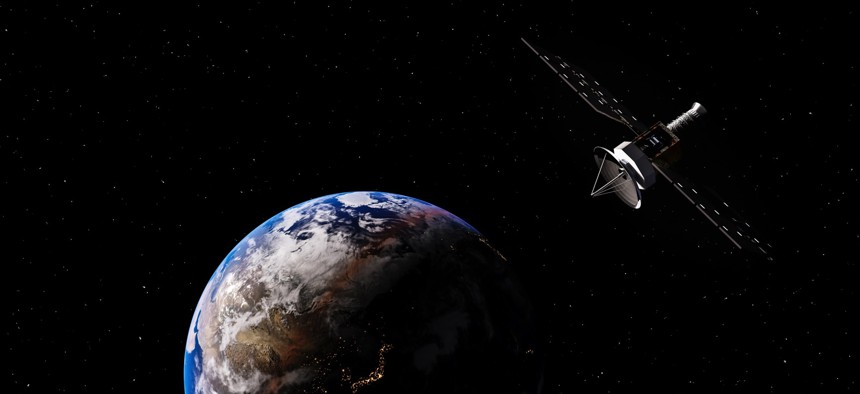
Artist's conception of a satellite OsakaWayne Studios



Quantum cameras could remake space-based intelligence
A Boston startup is getting ready to test a new imagery method for orbital satellites.

Can quantum physics enable better, cheaper, faster satellite photos? In a month or two, a startup will test a “quantum camera” for space-based imaging. If it works, it could slash the cost of missile defenses and give smaller NATO allies and partners spy-satellite capabilities that were once exclusive to major powers.
Funded in part by NASA and DARPA, the Boston-based Diffraqtion is testing a radically different way to make images from photons.
You might think that the cameras on the world’s most expensive satellites are fundamentally different from what your grandfather used to take old movies. But whether using chemicals and paper or chargeable transistors on a circuit, the process of deriving images from the behavior of photons has changed little in more than a century. That is one reason why space-based image collection—especially at high resolution—is incredibly expensive.
It’s also why Johannes Galatsanos, Diffraqtion’s co-founder and CEO, uses the term “quantum camera” rather than “photography.”
“You basically have light coming through a lens; it hits a sensor, and then that sensor takes a JPEG, an image, and then you can view it… or you can run AI on top, right, and detect things,” Galatsanos said. “Whether in space with high-resolution digital cameras or old-fashioned pinhole cameras, that process hasn’t [changed].”
That traditional method limits what can effectively be photographed based on diffraction, the process by which light beams pass through an aperture. It’s also a reason why high-resolution imaging satellites, like the WorldView-3, are large and heavy: like a telescope, they are mostly glass lenses and empty space. This is a reason why launches cost an average of about $50 million per satellite, and why why only a few countries have access to high-resolution satellite imagery.
Quantum science opens the possibility of collecting images using sensors that don’t require the same dense, heavy components. One of Diffraqtion’s cameras is the size of a small suitcase, launchable for just half a million dollars..
That just might be the key to shooting down highly maneuverable hypersonic missiles, as envisioned by the White House’s Golden Dome effort. The method proposed by Diffraqtion might lower the cost of the imaging systems on space-based interceptors, or even reduce the number needed to do the job.
“You have more area coverage, you can look at more targets at the same time, and so on,” said Galatsanos.
The idea effectively reverses the process of deriving an image from photonic data. But in quantum science, the simple act of observing quantum behaviors changes them. That’s useful for things like quantum encryption because it means that the message changes—obviously so—when intercepted. But it is also what makes quantum “photography” impossible.
Saikat Guha, another co-founder and the company’s chief science officer, has spent several years describing a new method for deriving information from quantum behaviors related to light. This method does not “observe” the photons in the traditional sense, nor does it act like a bed of capacitors or a sheet of film. Instead, it uses AI to model the optical field; so, rather than treating the scene as a blurry picture on a sensor, Guha’s method treats the arriving light itself as the ‘thing’ to be measured via quantum mathematics.
“What we do is [take] light as it comes to us. The visible light coming—we don't capture it, so there's no observation. But we transform the light, and at the end, when we have done the transformation, then we capture it. So we still retain the entire information of the photon as it traverses through the camera. And at the very, very end, we can observe the outcome of that processing,” said Galatsanos.
Galatsanos says that a wide constellation of quantum camera satellites won’t be possible before 2030. But if the hypothesis proves out next month, it could change all aspects of space satellite imaging.