

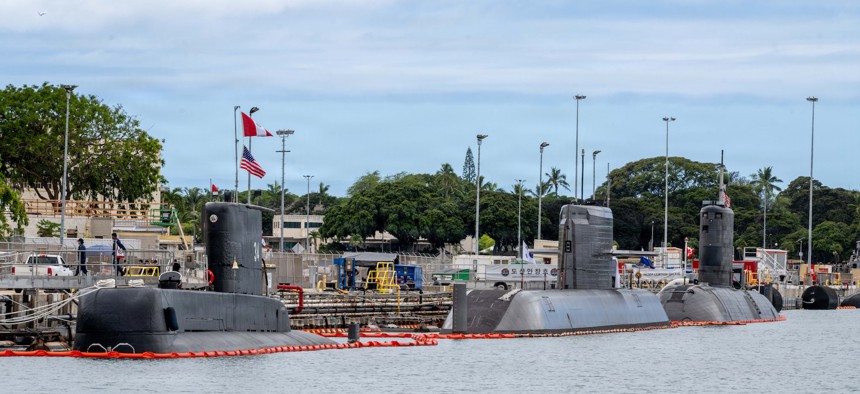
Peruvian Navy submarine BAP Chipana (left), Republic of Korea submarine Dosan Ahn Chang-ho, and Royal Canadian Navy submarine HMCS Corner Brook moored pierside at Joint Base Pearl Harbor-Hickam, Hawaii, in preparation for Exercise Rim of the Pacific 2026, June 23, 2026. U.S. Navy / Chief Mass Communication Specialist Omar A. Dominquez


RIMPAC kicks off in Hawaii with a focus on experimentation
The theme of this edition of the biennial exercise is “partners: integrated and prepared.”

JOINT BASE PEARL HARBOR-HICKAM, Hawaii—The 30th iteration of RIMPAC will feature 30 to 35 experiments that involve unmanned systems, the Pacific Fleet’s second-in-command said Wednesday.
The experiments are “a major part” of this year’s edition of the biennial Exercise Rim of the Pacific, Vice Adm. Jeffrey Jablon told reporters at a press conference. He declined to provide specifics.
Along with the drones, RIMPAC also includes 30 countries, 31 surface ships, five submarines, and nearly 200 aircraft, Jablon said. While the theme is “partners: integrated and prepared,” he said his top priorities for each of the 30,000 participants are “safety, environmental stewardship, and professionalism.”
Though deterring China while getting ready to defend against a potential attack is a major focus for U.S. Indo-Pacific Command, Jablon said RIMPAC “is not about any one particular country or a deterrent for any one particular country.”
And the war with Iran “had no impact” on RIMPAC, Jablon said. “The United States is contributing the same number of forces that we normally contribute.”
Jablon is serving as the commander of the combined task force for RIMPAC. Underscoring the partnership aspect of the exercise, the deputy commander is a Chilean navy officer, the vice commander is a Japan Maritime Self-Defense Force officer, the maritime component commander is a Korean navy officer, and the air component commander is a Royal Canadian Navy officer.
The exercise will end with the sinking of two decommissioned U.S. Navy ships.