

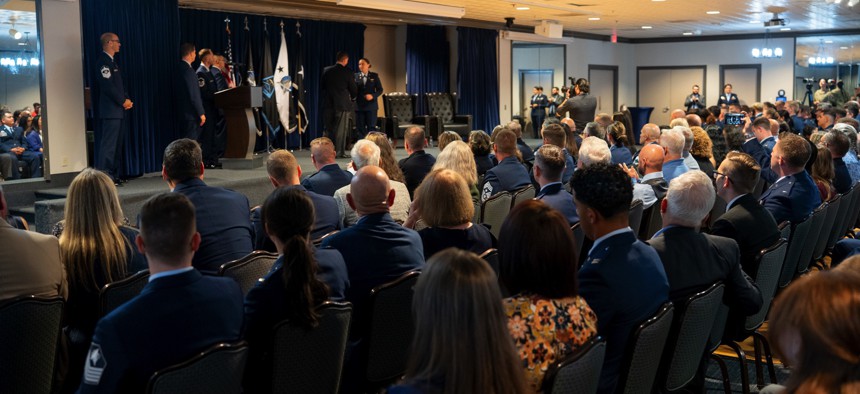
Guardians, instructors, and guests gather during the Officer Training Course graduation at Peterson Space Force Base, Colorado, Aug. 28, 2025. U.S. Space Force / Isaac Blancas


There’s a divide within the Space Force. Congress is forcing the service to address it
The new service was supposed to meld the “tribes” of operators and acquisition specialists. It didn’t happen.

A year ago, the leaders of the House Armed Services Committee put the Space Force on notice. The service, they said, was putting too much focus on its operators and not enough on its acquisitions corps—an imbalance that might ultimately harm the U.S. military's ability to preserve its edge in space.
“We fear a divide that elevates operators at the detriment to other core functions of the Space Force will have negative impacts, potentially not immediately, but as we look to 2030 and beyond,” Chairman Rep. Mike Rogers and ranking member Rep. Adam Smith wrote in a December 2024 letter to the service. Later that day, Rogers told a think-tank audience that “for the Space Force, and the joint force to succeed, we must have guardians that are just as comfortable operating in space as they are breaking down a requirements document.”
Since then, the divide has only gotten worse, according to lawmakers, guardians, and others in the defense, policy, and Congressional spheres. One military policy expert described the split between operators and acquisition officers as “an ongoing fight for the core culture of the Space Force.”
This week, the House passed the compromise 2026 National Defense Authorization Act, which contains a section requiring the Space Force to train and assign an equal number of operations and acquisition officers.
“Things have not improved,” a source familiar with the committee process told Defense One. “A year later, this being in the NDAA indicates that there's still an issue.”
A service divided
It’s an issue that long predates the Space Force itself, which will celebrate its sixth birthday later this month.
In 2001, the “Rumsfeld Report” suggested that merging at least some of the military’s far-flung space-related organizations would enable leaders to better set priorities and seize opportunities. The acquisitions-focused Space and Missile Systems Center was consequently removed from Air Force Materiel Command and placed under Air Force Space Command. That made AFSC the only one of the service’s nine major commands to house both operators and acquirers.
“You had a tension built into Air Force Space Command, right from the start, which was ‘what voice really matters?’,” said Paula Thornhill, a retired Air Force brigadier general-turned-professor at Johns Hopkins University. “This tension has always been there.”
The tension was perceived as a danger to the military’s ability to maintain its edge in space.
“There was this historical chip on the shoulder and the belief that ‘operators were supposed to be the kings and acquirers are supposed to be the servants’ and that is, unfortunately, not how space works,” one Space Force insider said.
In 2019, Air Force Space Command became the Space Force, in large part to unite space-related acquisition and operations workforces under a service branch—and to merge the tribes.
“When we were first standing up Space Force, a primary goal was to establish a culture without the tribalism often seen in the other services, while still developing the demanding technical skill sets needed to be an effective warfighting force,” said John Shaw, a retired Space Force lieutenant general and former deputy head of Space Command.
Initially, leaders had visions of “badgeless” officers who could handle both acquisitions and operations, but this never came to fruition, defense experts and service insiders said.
Part of the problem was that the troops who made up the Space Force in its earliest months and years came not just from the Air Force but from space-related units all over the military. Another part was that several space-related functions remained in the Air Force proper or in the newly reconstituted U.S. Space Command, a combatant command. Both hindered the development of a single culture within the new service branch.
“The establishment of the USSF, U.S. Space Command, and other changes in how DoD organizes for space…will continue to affect the development and fielding of space capabilities and forces, the execution of operations, and how services and combatant commands unite service components into a joint force,” RAND researchers wrote in 2024. "These major organizational changes are still unfolding and will have implications for the [Department of the Air Force]. DAF senior leaders will have to navigate and understand these changes to inform its approach to long-term air-space integration.”
In September 2024, the Space Force opened a new Officer Training Course, a 12-month program for officers joining the service. Officials hailed it as a unifying experience where “officers learn to be a guardian first and specialist second.”
But the course has an operational bent, with acquisition largely left for subsequent specialist training, insiders said. And the first assignment for OTC graduates is in operations; officers who want ultimately to pursue careers in acquisition must wait.
"I know what I'd do if the [Department of the Air Force] paid for my shiny new engineering degree, then sent me to a year of non engineering training then a tour of non engineering work. I'd leave as soon as it's over," read one post on a Space Force subreddit.
One defense expert said the tilt was widely perceived to reflect the priorities of the service’s top officer: Chief of Space Operations Gen. Chance Saltzman, a career operator who has served as an ICBM launch officer and a National Reconnaissance Office satellite controller.
In his December 2024 speech at CSIS, Rogers praised Saltzman and his predecessor, Gen. John Raymond—another longtime operator. But the HASC chairman pointedly warned that acquirers need a voice in leadership as well.
“The Space Force has to be led by more than just operators,” Rogers said. “They must recognize the contributions of all career services if it is to be successful. A deep understanding and connection with technology is at the core of the Space Force. Operators, acquisition, intel, and cyber professionals must all be on equal footing. The future of the Space Force will depend on its ability to both nurture these unique specialties and tribes, while also creating a unified fighting force.”
2025
Saltzman has vigorously answered Defense Secretary Pete Hegseth’s calls to “restore a warfighting ethos” across the military. In public remarks, policy documents, and memos to the force dubbed “C-Notes,” the CSO has urged guardians to embrace an operational focus and warfighting identity. In June, he left his Space Operations Badge off for his official military portrait, a deliberate move intended to convey the idea that all Space Force troops are operators.
“Contesting a physical domain is a complex endeavor—it takes a purpose-built service to do so effectively,” Saltzman wrote last month. “It also requires service members who have a deep understanding of military operations specific to their domain.”
Thornhill, the Johns Hopkins professor, said those shifts are unsurprising, given Hegseth’s purges of top officers.
“If that's what the Secretary's pushing, and you want to keep your job in an environment where you've seen a dozen flag officers fired, you better be talking about lethality and war fighting,” she said.
In May, the acquisition corps lost a key voice atop the Space Force, seemingly bearing out Rogers’ warning. Vice Chief of Space Operations Gen. Michael Guetlein, an acquisition specialist, was transferred to a new Pentagon job: implementing the sprawling vision of the Golden Dome missile defense system.
“There has been a growing animosity between the operators and the acquirers, and that friction kind of reached its apex between Saltzman and Guetlein,” one defense expert said.
Guetlein’s replacement, Gen. Shawn Bratton, has an operations background: he has served as Space Command’s deputy director for operations and the first head of Space Training and Readiness Command.
“The problem is now you have two folks who were both heritage operators,” a Space Force insider said. “So, now you don't have anybody who represents the acquisition side of the service in the front office.”
Guetlein departed just as the Space Force’s acquisition corps was beginning to reel from Hegseth’s hasty push to shed tens of thousands of Defense Department civilians in the name of efficiency. By May, the service had lost 14 percent of its civilian employees, many of whom worked closely with the uniformed acquisition specialists. In September, Saltzman estimated that Space Systems Command alone was likely to lose 10 percent of its workforce.
Industry has taken notice of the strain.
“You can tell that they’re stressed,” Kay Sears, a Boeing Space vice president, said at a think-tank event last month. “You can tell that they’re overworked.”
But the Space Force insider said Saltzman has some reason to be frustrated with his service’s acquisition performance.
“Certainly the acquirers in the Space Force haven't done a great job of doing well by him either,” the insider said. “They can't deliver anything on time, which is a whole different problem.”
The Space Force’s next-generation Overhead Persistent Infrared missile warning satellite, first announced in 2018, has slipped its initial 2023 launch date estimate to March 2026. The decades-long and multi-billion dollar Next Generation Operational Control System program for GPS has been highly scrutinized as a “poster child for broken space acquisition programs.” The Space Development Agency’s missile warning and tracking satellites have experienced repeated delays.
Efforts to fix the divide
The Space Force has made several changes to increase cooperation and make peace between the acquisitions and operations camps.
In August, it created Systems Delta, a new command structure meant to increase communications between program offices and operations-focused mission deltas.
In September, Saltzman announced that graduates of the Officer Training Course who choose a career in acquisition can attend a 10-week “first of its kind” Acquisition Initial Qualification Training course.
The CSO also took pains to tout his acquisition corps.
“The Space Force, by percentage, has by far the largest acquisitions workforce of any service. Uniformed guardians in acquisitions roles make up over 49% of our officer corps,” he said in his speech at the Air & Space Force Association conference. “Space acquisitions is one of the most intricate professions on – or off – the planet, and it can take years to master. At the pace the Joint Force is demanding our capabilities, we will need an expert workforce to deliver.”
Last month, nine operations officers from intelligence, cyber, and space backgrounds graduated from the first AIQT course, a service spokesperson said. Those officers will be assigned to program and engineering technical management roles.
And more acquisition coursework is being added to the one-year OTC course, which currently spends two weeks on the topic, Maj. Kaitlin D. Holmes, an Air Force spokesperson, confirmed to Defense One.
“The Space Force continues to iterate the OTC curriculum to increase the acquisitions segment and better integrate all segments, as opposed to teaching all segments separately in silos,” Holmes wrote.
What comes next
On Thursday, the House passed the NDAA with the section requiring the Space Force to train and assign an equal number of operations and acquisition officers. The bill now awaits passage by the Senate and signature by President Trump.
Once that happens, the Air Force secretary will have two months to submit a report giving the number and percentage of the service’s officers in both career fields and detailing “any identified shortfalls or imbalances in acquisition manning relative to operational manning in the Space Force; and actions taken or planned to achieve and sustain comparable manning levels for billets in acquisition and operations,” the NDAA reads. New versions of the report will be due each Oct. 31 through 2030.
The bill also requires quarterly briefings by the secretary to the HASC and its Senate counterpart on these topics and on “the development of the curriculum” to balance acquisition and operations focus.
Shaw, the former deputy head of Space Command, applauded the changes to OTC and called for more efforts to give equal attention to operations and acquisitions.
“The challenge will be developing effective career paths for officers and enlisted that continue to grow needed expertise in space operations, intelligence, cyber, and acquisition, while avoiding tribalism,” he said.
All this will not be quick or easy, but it must remain top of mind for service leaders, the Space Force insider said.
“Until we fix this, we are going to continue to fall behind,” the insider said. “This is not a problem we're going to fix easily. This is something we have to focus on over the years in order to go ahead and correct.”
Air Force and Space Force spokespeople did not respond when asked about the NDAA language or the implications of a divide between the service’s operators and acquirers.
A Space Force officer told Defense One that the space force has talented service members, and hopes that prioritizing a like-minded mission will create unity, no matter what background or experience a guardian comes from.
“We can do both [missions] even better than we are today, but we do both well, and that cultural aspect of building space-minded guardians who think about these things from the beginning of their career is going to pay long-term dividends,” the officer said. “We need to grow people that think about the domain differently, and we can do that both in acquisitions, engineering and operations under the Space Force.”
Help us report on the future of national security. Contact Thomas Novelly: tnovelly@defenseone.com, tomnovelly.01 on Signal.
NEXT STORY: ‘Enemy from within’? NORTHCOM commander says he hasn’t seen it