

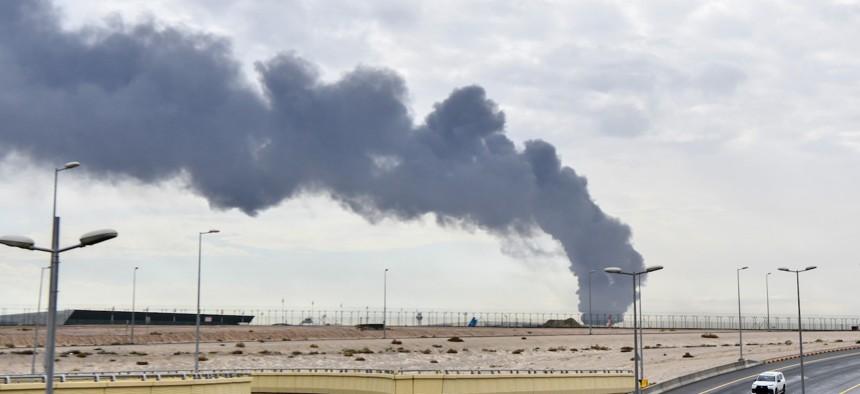
Smoke rises after Iranian drone carried out an attack on a fuel depot at Kuwait International Airport, March 25, 2026. Stringer / Anadolu via Getty Images


Iran is adopting Russian drone tactics, Ukrainian troops say
“Iran, North Korea, China, and Russia—that's all one war,” visiting military delegation tells D.C. audience.

Iran is using Russian drone-warfare tactics to target U.S. forces and other operations in the Middle East, Ukrainian military personnel said Thursday in Washington, D.C.
Last June, Iran responded to U.S. strikes on Iranian nuclear facilities with drones and missile attacks that were largely thwarted by U.S. and Israeli defenses.
But Iranian tactics have “changed from July last year to now,” one of the visiting Ukrainian military members told a small group of former government officials, analysts, and media at the German Marshall Fund on Thursday. “Now, those tactics are very similar to the Russians we’re fighting.”
Instead of large “existential” attacks, Iran is launching smaller numbers of drones and missiles, but more often, and at a wider variety of targets—including civilian and economic infrastructure that is a lower priority for U.S. forces to protect, as documented by the Institute for the Study of War.
Tehran has largely decentralized its operations and instructed commanders to "fire at will," ISW said. And while ISW suggests that U.S. efforts to incapacitate Iran’s missile and drone capabilities will likely work eventually, Iranian tactics have caused U.S. casualties, damaged bases, and created other disruptions.
The Ukrainian troops said this new strategy mirrors the “attrition” strategy Russia has used against Ukraine: aiming at civilian and infrastructure targets to impose economic and political costs.
ISW reported a similar finding on March 15, saying that Iran seeks to “outlast Washington rather than to militarily defeat it outright.”
The visiting Ukrainians reiterated what top E.U. officials and U.S. intelligence sources have previously stated: that Russia is providing Iran with targeting intelligence. On March 15, Ukrainian President Volodymyr Zelenskyy noted that Russia had supplied Iran with Shahed-136 drones before the U.S. and Israeli launched their surprise attacks in February.
Meanwhile, the war with Iran is having other negative effects on the U.S., Europe, and Ukraine. The United States has suspended sanctions against Russian oil interests and some Iranian oil producers, effectively boosting the finances of two nations aligned against it, even as Washington carries out military strikes against one of them.
However, the White House, has been reluctant to call out Russian President Vladimir Putin's regime for assisting Iran. Instead, President Donald Trump this month snubbed Ukraine’s offer to help the U.S. better defend itself against Russian and Iranian drones.
Some U.S. and NATO military leaders are more open to Ukraine’s assistance. The visiting military officials said that over the last few days, they met with military officials involved in the Defense Department’s “drone dominance” effort launched in July, as well as officials tasked with counter-UAS operations.
During a Tuesday hearing, Space Force Director of Force Structure Lt. Gen. Steven Whitney praised Ukrainian innovation as “out of this world.” Military officers across all ranks also routinely attest to the value partnership with Ukraine is bringing to U.S. military readiness.
That partnership is particularly important now, said the visiting Ukrainian military personnel, as autocratic states increasingly align to weaken the United States and Europe.
“Iran, North Korea, China, and Russia—that's all one war,” said one.