

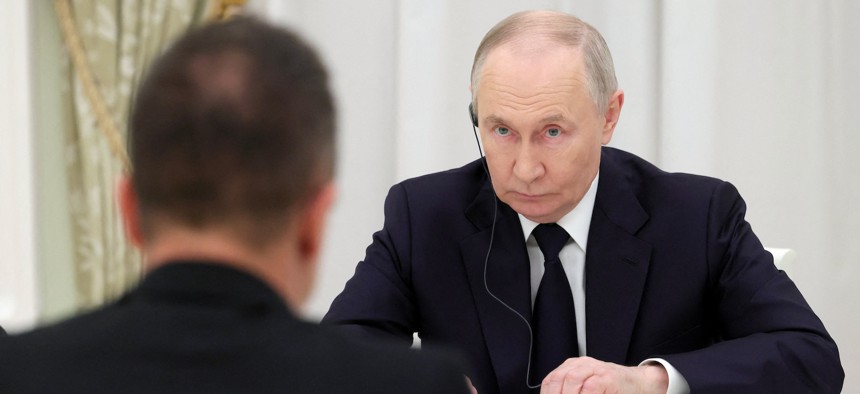
In this pool photograph distributed by the Russian state agency Sputnik, Russia's President Vladimir Putin (R) meets Hungarian Foreign Minister Peter Szijjarto in Moscow on March 4, 2026. Mikhail METZEL / POOL / AFP via Getty Images

Why the ‘narrow,’ ‘short-term’ sanctions reversal for Russia is neither
Sanctions relief for Russia will be difficult to undo.

The Trump administration’s “narrowly tailored, short-term” lifting of sanctions on Russian oil may produce a longer-term boost to Moscow’s war on Ukraine.
Treasury Department Secretary Scott Bessent insisted that wasn’t so as he announced on Thursday that countries would be allowed to purchase any Russian oil in ships at sea as of March 12.
The move “will not provide significant financial benefit to the Russian government,” Bessent wrote on X.
But experts, European allies, and Democratic Party lawmakers said Russia would indeed gain from Trump officials’ attempt to buffer Americans and global markets from the effects of their war on Iran.
The windfall could reach $10 billion a month, estimated Isaac Levi, an analyst with the Centre for Research on Energy and Clean Air.
Six members of the European Group of Seven condemned the move because “Russia is benefiting from that,” German Chancellor Friedrich Merz said on Friday.
Two members of the U.S. Congress wrote Bessent to “demand the immediate reversal” of his decision.
Earlier in March, Trump made the decision to ease oil sanctions specifically for India, a preview of the larger expansion in sanctions reversal. “Even more troubling than the rise of oil prices is the lifeline the United States has given to Russia just as U.S. officials confirmed Russia is providing Iranian forces with the locations of American military assets, including warships and aircraft. By providing this waiver, you have signaled that the United States will reward attacks on our troops, not deter them,” Rep. Sam Liccardo, D-Calif., and Sen. Ruben Gallego, D-Ariz., wrote in a March 9 letter about the sanctions reversal specifically for India.
“Short term”
Sanctions are “hard to put back on once taken off,” wrote Mike Pompeo, who as Secretary of State in the first Trump administration withdrew from a deal that was limiting Iranian nuclear development. Dropping sanctions also removes “leverage,” Pompeo wrote in a 2023 book.
Doing so before the punished country changes its behavior returns a situation to “factory settings,” diminishing pressure without getting much in return, Washington Institute analysts wrote of Iran four years ago.
The relief won’t likely enable Moscow to open new fronts in the Ukraine war immediately, Elina Ribakova, a senior fellow at the Peterson Institute for International Economics, told the Wall Street Journal, but: “I would worry that if it were to hold for half a year that Russia would gain more appetite to do so.”
The move also weakens European allies politically. The EU has banned 90 percent of Russian oil sales, and those sanctions are likely to remain despite the fact that energy prices in Europe are higher than they are in the United States. The White House move counteracts the effect of those sanctions while keeping prices higher in Europe (as they maintain their own sanctions.)
Sanctions are only being lifted on oil “loaded on vessels” by March 12, the Treasury Department notice said. But that will be difficult to enforce because of Russia’s widespread use of illicit “shadow fleet” tankers that mask their identification numbers, ports of origin, and cargo.
“Data on how much, and most importantly whose oil a tanker is carrying, is much more sensitive for the owners and practically unverifiable,” Dmitry Nekrasov, an economist with the Center for Analysis and Strategies in Europe, has noted.
Satellites and AI have made it somewhat easier to track shadow fleet vessels, but the Trump administration has fewer people around to do so.
Within weeks of taking office last year, the administration disbanded a Biden-era task force that was central to enforcing sanctions against Russia. The administration also froze and restricted hiring for federal jobs, including at Treasury offices that monitor sanctions. Last April, Senate Democrats reported that the team “has been unable to keep pace with the attrition caused by numerous staff departures.
“The Trump Administration let pressure dissipate despite the growing number of Russian circumvention efforts, and it has stood by as evaders in the PRC [China] and other countries have profited from their support to the Kremlin’s war machine,” their report said.
One official who is welcoming the break from sanctions is Russia’s Kirill Alexandrovich Dmitriev, an envoy of Vladimir Putin and the head of the country’s sovereign-wealth fund.
“Russian energy is indispensable to easing the world’s largest energy crisis. EU bureaucrats will soon be forced to recognize this reality, acknowledge their strategic blunders, and atone,” Dmitriev wrote on X, about a day after he met in Florida with White House special envoy and real-estate mogul Steve Witkoff and the president’s son-in-law, Jared Kushner.