

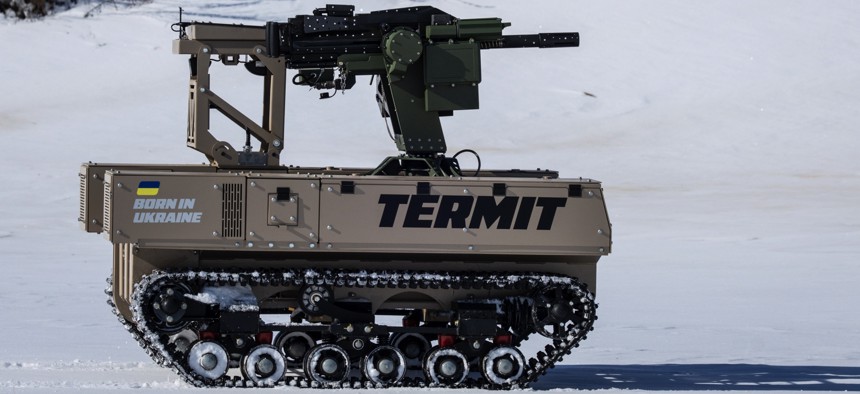
A Tencore TerMIT unmanned ground vehicle drives through the snow during a February 20, 2026, demonstration near Kyiv, Ukraine. Chris McGrath/Getty Images



Several trends are shifting defense tech toward Europe
War, regulation, and distrust of the United States are tilting a big market homeward.

Donald Trump’s break with the liberal democracies of Europe couldn’t have come at a worse time for U.S. defense and tech giants, whose market dominance will be challenged by European competitors riding several favorable trends.
One is geographic: EU policies now coming into force mean U.S. firms will have to alter their strategies and practices—or lose access to a critical market. On the military side, the role of Ukraine in military technology innovation benefits European partners that are closer to the front line. Another is technological: At a time when faster tech cycles and open-source software make it easier for startups to challenge the giants, venture capital is flowing to European defense firms and a few U.S. startups. Yet another is, perhaps, philosophical: Europe is souring on the 21st-century bargain in which U.S. tech services are purchased, in part, with access to European data.
All this suggests that while Europe will find it difficult to uncouple quickly or entirely from the U.S. defense and tech industries, a new order is coming.
No divorce yet
Even as European policymakers elevate concepts like digital sovereignty and strategic autonomy from interesting discussions to formal goals, decades of dependence on the U.S. military and industry are not so easily undone.
U.S. defense firms account for nearly half of global sales, while European companies account for just under one-quarter, according to a Feb. 12 report from the McKinsey consulting firm. Europe buys about half of its defense goods from U.S. firms, a proportion that has grown in the past five years, the report says. And European governments are completely dependent on U.S. suppliers for some key capabilities such as large satellite constellations for internet connectivity or earth imaging.
As NATO Secretary General Mark Rutte, who has referred to Trump as "Daddy," told alliance members earlier this month, “Europe can defend itself without the US? Keep on dreaming. You can't.”
The biggest hole in Europe’s plans for technological independence may be the cloud. Distributed large-scale data storage and retrieval are all but essential for modern weapons, defense manufacturing, societal resilience, and military operations; they are vital for autonomous systems and tools that use generative AI and large language models.
Some 80 percent of European spending on cloud services goes to U.S. companies, according to a December report by the European Commission. Even European officials concede that they have no near-term alternatives to U.S. enterprise cloud and data integration companies. But European governments who worry about their dependence on U.S. tech are openly rethinking their relationships with companies like Microsoft, Palantir and others.
"There is no quick fix," an analyst with a leading U.S. consulting firm told Defense One. “Given the annual capital and operating spend of hundreds of billions over multiple years from the hyperscalers”—the U.S. giants of computing—“we are not yet seeing a comparable European alternative.”
While that’s the picture today, it’s not a permanent one.
Regulation
U.S. executives love to point to EU regulations that hurt European competitiveness—for example, the General Data Protection Regulation. But a pair of new laws aim to help European digital-services companies grow—and will require U.S. firms to adapt.
The Digital Networks Act will replace multiple regulatory schemes with a single one, enabling companies to expand more quickly throughout the EU. The 2024 Data Act, now coming into force, gives users ownership over device-generated data and makes it easier for Europeans to switch cloud providers.
U.S. cloud providers that want to stay in the European market must create EU-based, or at least EU-compliant, versions of their products. These “sovereign clouds” must run on and store data in centers on the European continent. Microsoft, AWS, and Google, for example, have worked with France’s Capgemini to do so, but it eats into U.S. companies’ bottom lines.
Cloud providers must also obey laws that prohibit unapproved sharing of EU-based data with, say, the U.S. government. The laws have teeth; in December, the EC hit X with a €120 million fine for DSA violations. But U.S. tech firms have also been threatened by the Trump administration if they comply.
And at least one analyst believes the DSA will force U.S. companies to open up their ecosystems and share intellectual property with European competitors. In October, AEI fellow Shane Tews argued that this will lead to “race to the bottom where copying existing features becomes more appealing than innovation.”
Ukraine the pioneer
Military tech is also becoming more European—specifically, Ukrainian. U.S. military commanders are closely watching as Ukrainian forces develop tactics and gear that have held Russian invaders at bay—and even defeated a simulated NATO mechanized attack. Last year, Gen. Alexus Grynkewich, the U.S. Air Force officer who is the alliance’s Supreme Allied Commander, urged U.S. companies to workshop their arms and gear on Ukrainian battlefields.
Eric Brock is a co-founder of the venture capital firm Ondas, which backs startups that work closely with Ukrainian troops. He said European governments increasingly want to buy made-in-Europe products. U.S. companies could approach this by seeking joint ventures with European firms—but he said that will require a humbler, more collaborative approach than U.S. companies have been used to.
“We…want to bring European capital as well to match ours. So it can't be the bigger, American company coming in and dictating,” he said. “I think it's going to be hard for the established defense manufacturers who are so embedded with the Department of War to localize in Europe. Some of the emerging players on the fast cycle, like the companies we are working with, will have an easier time.”
Europe’s defense firms have typically moved more slowly than their American counterparts. One way to measure this is backlog-to-revenue, the time between taking an order and delivering a product. It’s an average of 3.7 years in Europe and 2.4 in the United States.
But Ukraine is showing the rest of Europe how to move more quickly. It has, for example, developed and mass-produced interceptor drones while the United States has struggled to deploy far fewer at far greater cost.
That ambition is proving contagious. On Feb. 2, Germany unveiled a new highly maneuverable hypersonic missile in a fraction of the time and cost it took U.S. firms to debut theirs.
New-tech spending
Europe is also putting a large portion of its new defense spending into new technology, rather than updating older tech. From 2022 to 2025, European defense-tech spending rose thirteenfold while U.S. spending on new tech only doubled, according to Jonathan Dimson, a senior partner at McKinsey, who added that investment in European defense-tech startups from 2021-2024 was more than five times greater than in the previous three-year period.
Europe has also noted how Ukraine’s use of open-source software has sped innovation, and the EU has explicit efforts to encourage its use. Google last week criticized the plan as anti-innovation, but investors who bet on open-source AI companies say they can out-iterate closed models. They point to China’s DeepSeek and Arcee AI, a U.S. company that in January released Trinity, a 400-billion-parameter open-source model. Arcee built the model for $20 million, a fraction of the amount that, say, Meta spent on Llama, co-founder Mark McQuade said at an January event in San Francisco.
“You're gonna have so many people building on top of that,” said William Sherman, whose AIN Ventures backs Arcee, “that those you already see those models getting are, like Mark said, getting close to as good as the closed-source models.”
The U.S. military is also pushing for open architectures and freer data sharing, often over the objections of large incumbent defense contractors.
“I'm very much encouraging any company interested in building that kind of open-source U.S.-based model to do so, and there's companies that are starting to do it,” Emil Michael, the defense undersecretary for research and engineering, told a small group of reporters last week at the AWS Defense Leadership Tech Summit in West Palm Beach.
Public distrust
Europeans’ growing distrust of the United States is dragging down their willingness to use U.S.-made tech. Public sentiment began to drop a year ago, after Vice President JD Vance’s speech at the 2025 Munich conference, said one U.S. financier who works with European and U.S. defense firms.
“The Europeans were aghast...They couldn't believe it. They were very upset. Very quickly. They realized that, okay, you know, ‘We have to be resilient,’” the financier said. “I don't think it's widely appreciated how big of a deal it is.
More recently, a poll by the Munich organizers showed that most European respondents strongly felt that Trump’s policies were bad for their countries. In September, a Pew poll found that 63 percent prefer European-made security technologies, even at a higher cost, because they see Trump’s influence as a security risk. Just weeks ago, a poll conducted by Swiss technology company Proton found that nearly three-quarters of Europeans believe that their countries are too dependent on U.S. technology.
Those changes in perception are especially relevant when it comes to AI, which U.S. hyperscalers are investing most heavily. European and U.S. citizens are increasingly aligned in wanting control over their own data and how AI is used in their lives, the Pew poll found.
Military officials also talk about the control they want from AI and defense contractors in general: control over the data that goes into model reasoning, control of or at least transparency into model processes, control over compute resources. That puts the Pentagon on a collision course with big tech, which wants to retain, or even increase its control over user data, compute infrastructure, and intellectual property.
All of this points to a great shift. Allies and consumers are skeptical of tech companies’ relationship with the White House. A new class of startups is emerging to compete against big tech providers. The Ukrainian model is shaping how every military thinks about the future of building and buying weapons.
Bottom line: While large U.S. tech firms will retain their leadership position for years, they are already becoming more European. And they’ll have to re-invent themselves in other ways if they are going to make the pitch that they can still grow and not just manage a slow decline.