

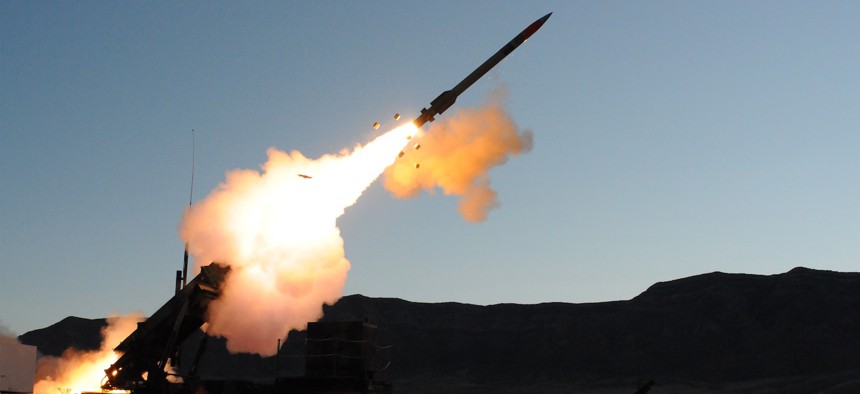
The PAC-3 MSE. U.S. Army / Darrell Ames

There’s no shortcut to replenish US munitions stockpiles
Firms are pitching low-cost munitions and the Pentagon is making weapons deals. It won’t immediately fix the Iran stockpile problem, experts say.
HUNTSVILLE, Ala. — As the U.S. military’s critical munitions are overused in the Iran war and underproduced at home, companies are eagerly pitching new low-cost solutions, and the Pentagon is keen to make big deals. But defense experts say those new, cheaper missile options—and the push to rapidly produce existing weapons—aren’t the short-term fix needed to overcome the long-existing problem exacerbated by the Iran war. However, they will provide the military much-needed options in the future.
At the Space and Missile Defense Symposium last week, Boeing unveiled a low-cost seeker missile, with crucial hit-to-kill guidance technology used on the PAC-3 missile, made of commercial, off-the-shelf components. At the same conference, Northrop Grumman released its “cost-effective” 50 millimeter gun-based drone defense system to “address a critical short-range air defense gap.”
And last month at the Farnborough International Air Show, Lockheed Martin announced a more affordable, proximity-detonation version of its Patriot missile. But those solutions will likely only have a significant impact on the Pentagon’s stockpiles if the Iran war drags on and if officials quickly award contracts.
“The push for low-cost munitions is unlikely to have a material effect on the Iran War—at least not anytime soon,” said Becca Wasser, Bloomberg Economics’s defense lead.
And, she said, making enough new weapons, at the right cost, is only part of the problem.
“Getting to a lower cost for exquisite munitions will take time. It requires developing new weapons or adapting old ones, which means going through new testing and evaluation processes,” she said. “If the Iran war drags on for years, that’s when the drive for lower cost interceptors and munitions could have an impact,” because “wars of attrition require enormous amounts of material—and the lower price tag helps.”
Right now, the Pentagon is blowing through its prized Patriot and Terminal High-Altitude Area Defense missiles, and they won’t get replaced anytime soon, defense analysts say—even with novel framework deals.
In the last year, top officials have been pushing those deals with major defense primes and are continuing the administration’s rallying cry for the firms to build and innovate faster. Some of those are starting to bear fruit.
This week, RTX netted a seven-year, $22.9 billion Tomahawk missile contract with the U.S. Navy under a new deal, showing that the military is making big bets on legacy systems as it pursues newer options.
But those legacy munitions still take time to manufacture. In a recent report, the American Enterprise Institute think tank found that it would take 27 years for defense contractors to produce THAADs at the current maximum annual rate of 96 interceptors a year to reach quantities the Pentagon wants.
There “will be a window of vulnerability for several years until inventories return to their previous levels, and another several years before they get to the levels that war planners desire,” according to a May report from the Center for Strategic and International Studies.
“These newer, lower-cost munitions absolutely should be part of the way we fix this. But we shouldn't be kidding ourselves that they're going to be ready quickly en masse, are operational, and our forces are trained and understand how to use them,” said Todd Harrison, AEI’s defense budget expert. “It will take years, some sooner than others. And I think it remains to be seen if they're going to be available in large quantities sooner than the reorders of the more exquisite existing weapons.”
Framework deals aren’t contracts
The Pentagon has already inked framework agreements for low-cost and traditional munitions. Overall, experts say they are a step in the right direction.
“It's not a contract, but it helps give the companies a demand signal they can take to their boards and their shareholders, and…it reduces their risks, so they can make increased capital expenditures, or capex, investments,” said Jerry McGinn, a CSIS senior fellow and the director of the Center for the Industrial Base.
McGinn teased an upcoming CSIS analysis that found publicly-traded companies with framework agreements increased their capex investment by 31 percent from the second quarter of 2025 to the same quarter this year.
“They're clearly investing more and it's hard not to tie it to those framework agreements. But the challenge is that the framework agreement is an agreement…It's a best faith effort. It's not a contract,” he said.
Congress still has to appropriate the money, the companies have to get on contract, and then they have to deliver, McGinn said. And none of that is guaranteed.
McGinn said he’s keen to watch how many contracts come out of the framework deals.
One of the first major contracts was a seven-year, $35 billion undefinitized contract with Lockheed Martin for THAADs, which leaves some aspects of the agreement open—to be finalized before the contract starts.
Undefinitized contract actions, or UCAs, require special approval and are used for urgent work that all parties “agree needs to begin before final agreement can be reached on price.”
Lockheed Martin executives said they’re up to the task.
“If you look at the framework agreements we've signed, we've leaned into the ask that the country has made of us. Lockheed Martin has never shied away from stepping up to the line and doing what's been asked,” Johnathon Caldwell, Lockheed's vice president of strategic and missile defense systems, told reporters at the Space and Missile Defense Symposium. “We're in an unprecedented era where speed matters, and we're able to bring capabilities to market in weeks and months, not years and decades. We're putting our money on the table, and our commitment.”
It’s a tall order for companies to surge production capacity of those munitions, especially amid supply chain bottlenecks for major components such as solid rocket motors.
But it helps that the Pentagon’s actually allocating and committing money to those problems, Bloomberg’s Wasser said.
“The framework agreements are just that—-agreements, not contracts. Until these are on contract, you won’t see a lot of companies surging production,” she said. “All these efforts—sending the demand signal to industry, qualifying more [solid rocket motor] suppliers, ramping up missile procurement—help, but they don’t solve the problem.”
Low-cost munitions, long-term solutions
Lockheed’s more affordable version of the PAC-3 missile comes with some tradeoffs, and a timeline.
“We basically modified the front end, modified the back end, took out the [Attitude Control Motors], so it's no longer hit-to-kill,” Jason Reynolds, Lockheed’s vice president and general manager of integrated air and missile defense, told reporters during a briefing at the Space and Missile Defense Symposium, adding that it integrates with existing munitions systems “at reduced range.”
However, PAC-3 ACE isn’t expecting a first flight until early 2028, and won’t go to production until 18 months after that.
“Everybody wants more air defense interceptors as quickly as possible, and anything that is as capable or nearly as capable as a PAC-3 MSC is a very attractive offer,” Reynolds said on the sidelines of the conference.
There’s no doubt that a more affordable version of the highly-sought after PAC-3 is useful, said Tom Karako, CSIS’ director of the Missile Defense Project. But the question remains: Will the Pentagon buy it?
“PAC-3 ACE is not a contract. It's a concept that they've had for a while and they rolled it out,” he said. “I think the time is right for PAC-3 ACE, but it's a concept, and if you're really attacking the root cause problem, you know the root cause here is the customer.”
A few weeks after the PAC-3 ACE contract was announced, Boeing unveiled its Ultra Low-Cost Seeker. It’s a push to make the company’s precision-guided technology, which makes Patriot missiles deadly and expensive, more accessible and affordable.
“The system uses commercial off-the-shelf components that Boeing adapted for military use,” the company said in a news release this month. “ULCS leverages our seeker expertise developed on programs like PAC-3 MSE, but delivers a different seeker capability that can be applied at low cost to numerous defensive and offensive products to address lower-complexity threats.”
The seeker is still under development, and more flight tests are expected in 2027. Officials declined to provide exact figures on how much more affordable the new product was compared to existing technology.
Overall, there seem to be more options for cheaper replacements to hypersonic or cruise missiles than for top-tier air defense missiles like Patriots and THAAD weapons, said Mark Montgomery, a retired rear admiral and senior fellow for the Foundation for the Defense of Democracies.
New entrants are also getting in the low-cost missiles game—and landing contracts. There’s Anduril's Barracuda, Zone 5 Technologies’ Rusty Dagger, and Coaspire’s cruise missile.
“We’re seeing it in hypersonic missiles with a company called Castelion…But we're not seeing it in air defense weapons,” Montgomery said.
X-Bow Systems revealed its modestly priced $100,000 drone destroyer at the Farnborough International Airshow. The company also landed a $11 million deal this week with the Missile Defense Agency to develop and test low-cost interceptors.
And the fact that these companies are landing contracts, may be indicative of faster production and delivery in a matter of several months, opposed to years, Montgomery said.
But producing low-cost munitions isn’t necessarily a solution to the U.S. military’s current stockpile problem.
“It's about transitioning your arsenal long term to a high-low mix. But some of these things can come soon,” Montgomery said. “So it doesn't impact the next stage of the war. But it could impact a 2027 end game. And it certainly will impact being ready in 2028, 2029 for Russia or China to do something.”
Strategic shifts
While industry is answering the call to build more affordable munitions, defense experts question whether the military is willing to use them.
In March, Joint Chiefs Chairman Gen. Dan Caine declared that the U.S. military was pivoting from “from stand-off munitions to stand-in munitions” meaning a pivot from long-range weapons outside the battlefield to ones that need to be dropped within conflict zones.
But CSIS’ Karako said there’s been no significant switch to plentiful GPS-guided, freefall weapons like Joint Direct Attack Munitions in the months since that statement.
"We have 140,000 JDAMS, we have low-cost munitions today. The reason that we're not using them, and the reason that we're hemorrhaging our Tomahawks instead, has to do with extreme risk aversion,” Karako said. “That risk aversion calculus is not going to change just because you have some new entrance, low-cost, low-range missile. We have, today, plenty of munitions that we could use, but we're not using.”
A month after Caine made his comments, a F-15E went down over Iran. The complicated rescue of the two U.S. airmen pushed President Donald Trump and Defense Secretary Pete Hegseth to proclaim the military had “achieved overwhelming air dominance and superiority” over the hostile territory.
Airpower experts previously told Defense One that broad terms used by the administration painted an inaccurate reality of the dangerous situation U.S. pilots find themselves in over the region. That lack of total control also limits which munitions the military is willing to use.
“Despite efforts to gain air supremacy over Iran, the U.S. was only able to gain localized air superiority over some parts. That reduced the ability to drop JDAMs instead,” Wasser said. “Switching to a strategy that relies on JDAMs would mean accepting more risk—or taking steps to further degrade Iranian capabilities to allow for greater U.S. use of the skies without threat.”
Experts told Defense One the Iran war has exacerbated long-standing problems with how the military uses and buys munitions. And while it’s possible the Pentagon could weather this conflict, the resulting mission depletion will likely make future wars—particularly with China—a struggle.
“These missiles will also be critical for a potential Western Pacific conflict,” an April CSIS report said. “Even before the Iran war, stockpiles were deemed insufficient for a peer competitor fight. That shortfall is now even more acute, and building stockpiles to levels adequate for a war with China will take additional time.”
Until production on existing munitions and interceptors ramps up and the Pentagon buys a new mix of high- and low-end missiles, Karako said the military should look at the plentiful munitions it already has—and use them.
“The more immediate thing that we could be doing is changing our tactics,” Karako said. “We've hemorrhaged our long-range stuff, and the thing that we could do is we could start using gravity bombs, but we're not willing to do that … Everytime CENTCOM fires a Tomahawk at somebody without air defense, an angel loses its wings in PACOM.”