

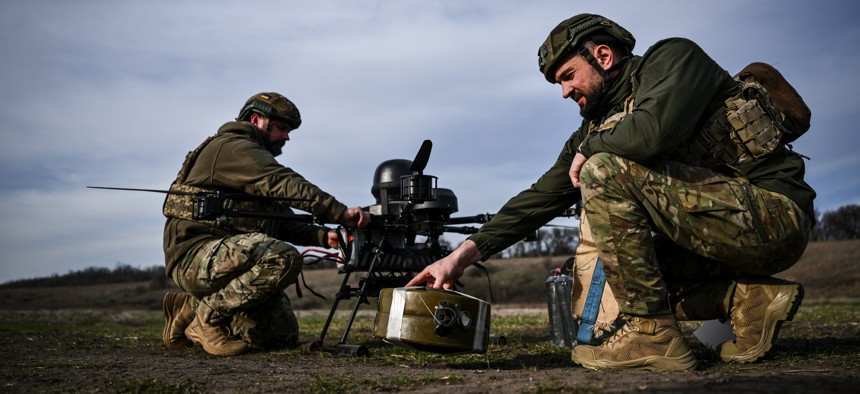
Soldiers from a drone unit of a battalion of Ukraine's 422nd Separate Unmanned Systems Regiment ''Luftwaffe'' prepare a Baba Yaga heavy bomber drone before a daytime training flight in the Zaporizhzhia direction, Ukraine, on March 23, 2026. Dmytro Smolienko/Ukrinform/NurPhoto via Getty Images


How Ukraine’s defense industry innovates at the speed of modern war
The reasons are far more organizational than technological.
The Pentagon is negotiating to buy Ukrainian interceptor drones, having concluded that no American manufacturer can match the price, delivery times, and battlefield-tested reliability. A drone developed by UK firm Skycutter with Ukraine’s SkyFall recently scored 99.3 out of 100 in the Pentagon’s own Drone Dominance evaluation, beating every U.S. competitor by more than ten points. Before Russia’s full-scale invasion, Ukraine had about seven domestic drone manufacturers. It now has roughly 500. Last year, they produced a rough total of four million drones, exceeding by far the combined output of all NATO members; in 2026, they are aiming to make seven million.
The technology is not the story. The organizational model behind it is.
What Ukraine’s drone ecosystem has built is what U.S. Air Force Col. John Boyd theorized in the 1970s and 1980s but almost no institution has managed to implement: a distributed observe-orient-decide-act architecture at industrial scale, where the feedback between battlefield observation and production action operates faster than any comparable system in history. Three principles from that model apply directly to how Western defense leaders think about acquisition reform.
Observation nodes belong at the point of use, not at the top of a reporting chain. In Western defense procurement, the distance between a battlefield observation and an engineering change is measured in years. After-action reports travel through chains of command, requirements committees draft specifications, and engineering change proposals enter configuration-management queues. Ukraine’s three-year-old Brave1 platform has created a national marketplace where frontline units order drones directly from certified manufacturers. (The platform has served orders totaling more than $235 million so far.) Real-time dashboards feed confirmed-hit data, strike distances, and failure modes back to producers continuously. The frontline operator is the primary sensor in the system, not a customer at the end of a supply chain. Put another way, the people who use the drones provide the design feedback that shapes the next production run.
Shared failure data is a strategic asset, not a competitive vulnerability. When Russia deployed stronger electronic warfare systems, Ukrainian engineers across the 500-company network responded simultaneously with fiber-optic guidance, encrypted multiband links, AI-assisted targeting, and hybrid systems that switch from fiber-optic to radio when the cable breaks. No single authority ordered these responses. Manufacturers share what breaks across competitors, and the shared orientation made the problem visible to everyone at once. Most solutions failed. The ones that survived combat testing propagated through the network within weeks. In most Western corporate and defense settings, failure data is hidden behind classification walls or treated as liability exposure. That is an orientation-impoverishment strategy, and it is one of the primary reasons centralized procurement systems cannot match the adaptation speed of a distributed network.
Decision authority belongs where the information is richest and most current. Ukrainian military units independently select which manufacturers to order from, switching suppliers based on what works under fire rather than waiting for committee approval. The soldier is the procurement officer. There is no requirements document, no multi-year contract cycle, no bureaucratic intermediary between battlefield judgement and resource allocation. Capital flows to demonstrated effectiveness, measured in confirmed hits, not to incumbency or contractual position. Boyd argued that decision authority must sit with the person closest to the most current information. Ukraine has institutionalized that principle in a manner that has no precedent in modern defense procurement.
Two Western cases demonstrate that these principles can work outside a wartime ecosystem. In early 2025, Saab, the Swedish Air Force, and the FMV developed and evaluated the Loke counter-UAS system in 84 days, not by circumventing regulation but by repurposing proven components and explicitly authorizing departure from standard process. From April through September, Loke was operational at Malbork Air Base, a NATO base in Poland.
And when U.S. engineers recovered a downed Iranian Shahed-136, they did not commission a requirements study. They disassembled it, rebuilt it with American guidance and satellite datalink systems, and fielded the LUCAS drone in about five months at $35,000 per unit. The Tomahawk it partially replaces costs north of $2 million. In both cases, the bottleneck was organizational, not technical.
There are, of course, real objections. What works under wartime emergency may not translate into the institutional architecture that sustained great-power competition demands. Fragmentation, corruption risk, and the absence of standardization are genuine constraints. These principles apply where the product is modular and the iteration cycle can be measured in weeks: drones, electronic countermeasures, software-defined systems. They do not apply to submarines or next-generation fighters. The argument concerns the growing category of defense capabilities where speed of adaptation determines effectiveness.
Consider the cycle time in your own organization between a signal from the front line and a change in what you produce. Consider who has authority to act on that signal without waiting for approval from someone further from the information. If the answers are months or years, and someone in a committee, Ukraine’s drone entrepreneurs have built the organizational proof that a faster, more adaptive model is not theory. It is operational, at scale, under fire.
The rest of us have the luxury of learning it before the pressure arrives.
Göran Roos is a retired Swedish Army Reserve major and a Visiting Professor in Business Performance and Intangible Asset Management at the Centre for Business Performance, Cranfield School of Management, Cranfield University.
Johan Roos is a retired Swedish Army Reserve captain and a professor in Strategy and Executive Advisor at Hult International Business School.