

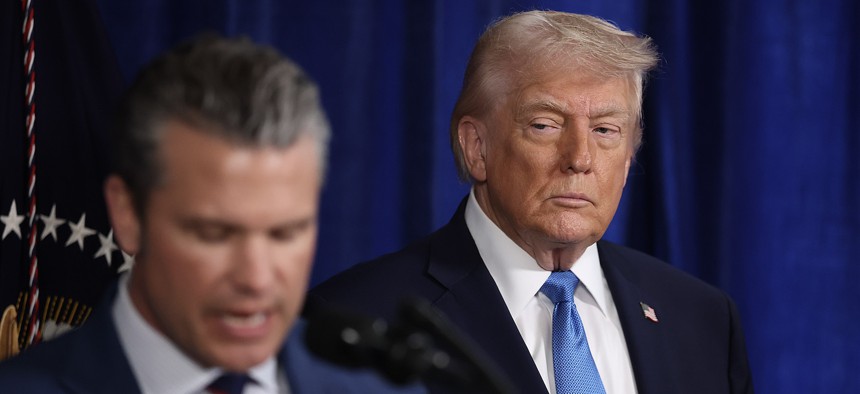
Defense Secretary Pete Hegseth speaks during a press conference with President Donald Trump on January 3, 2026, in Palm Beach, Florida. Getty Images / Joe Raedle

Trump’s national defense strategy is unlike anything that’s come before it
It touts an end to interventionism and regime change, despite adventurism in Venezuela and Greenland.

The Pentagon’s new National Defense Strategy is a major departure from decades of established defense policy, and may not be sustainable, according to experts who spoke to Defense One.
While the strategy hearkens back to what the Trump administration sees as a better time— immediately after World War II, “secure in our hemisphere, with a military that was focused on warfighting and far superior to anyone else’s”—experts don’t believe this worldview is built for the long haul.
“I don't think it will be a lasting change,” said Todd Harrison, a senior fellow at the American Enterprise Institute. “Right at the very beginning, they basically say they don't believe in a rules-based international order. And I don't think that there is a consensus in the United States about that.”
This framework, established after the second world war, promotes the values of classical liberal democracy and encourages cooperation with international partners. Indeed, more than half of Americans recently surveyed on U.S. leadership abroad support more engagement rather than less, including more than 60 percent of Republicans.
Trump’s new NDS calls the international order that has seen the U.S. advancing its values abroad a “cloud-castle abstraction.” That’s a 180-degree turn from the guiding principles of national defense for both parties over the past 80 years.
Even during Trump’s first term, when his efforts to disconnect from established allies and partnerships led Defense Secretary Jim Mattis to resign in protest, the president nominated a successor who vowed to uphold those relationships. “I'm fully committed to that,” Mark Esper—whom Trump would fire after his 2020 election loss— told senators during his 2019 confirmation hearing. “I realize the importance of it. The international rules-based order in the wake of World War II is the order that has ensured prosperity and security now for 75 years. And I'm fully committed to that.”
This time, Trump has a different lineup crafting his defense policy.
“So I think it's fair to say that the second Trump administration's defense strategy is at war with the first Trump administration's defense strategy,” Harrison said. “And I think that reflects the cast of characters that they brought into the Pentagon. There's no Jim Mattis. There's no steady hand at the wheel.”
Or perhaps, the administration is distancing itself from its first iteration. The new strategy briefly mentions Trump’s attempts to build up the military, then says the Biden administration degraded it again.
“It appears to lump the first Trump administration in with all of those failed national-security ideas,” said Mark Cancian, a senior adviser with the International Security Program at the Center for Strategic and International Studies. “It's just, ‘everything before now was a failure and naive’.”
In a speech at the Sejong Institute in South Korea on Monday, Elbridge Colby, the Pentagon’s policy boss and a key author of the NDS, reiterated his thoughts, this time calling the international order a “gauzy abstraction” that left America “holding the bag” on the defense of Europe in the face of Russian incursions.
Said Harrison: “American history and our defense strategy has relied on an idea that advancing American values is the best way to advance American interests. And this is a departure. This document makes clear it doesn't care about advancing values, and it has a very narrow view of what those interests are.”
The NDS calls for a return to the Monroe Doctrine, of hemispheric isolationism, with a “Trump corollary” that calls for “American military dominance” in the Western Hemisphere, denying “adversaries’ ability to position forces or other threatening capabilities in our hemisphere.”
“There's some internal inconsistency,” Harrison said. “They acknowledge the whole ‘moat theory’ of national security, that we've got these two big oceans protecting us on either side—and they acknowledge that that doesn't work anymore in the age of cyber and missile threats. But at the same time, the strategy is pulling back to our hemisphere, as if those moats will protect us.”
The document is even remarkably different in the way that it’s written, Cancian said. Trump’s first NDS doesn’t include his name at all, and Biden’s appears twice in the 2022 version.
In the document released on Friday, Trump’s name appears 47 times, or about twice per page. It’s 52 times if you count the mentions in Defense Secretary Pete Hegseth’s two-page introductory memo.
New priorities
Hegseth had originally promised the full version of the strategy in late summer, an ambitious timeline compared to previous strategies. But the Pentagon held off until two months after the White House released its National Security Strategy. The final version adds ideas from the interim NDS that align more with the NSS.
While the interim version said the first priority was “defending the homeland,” the priority now includes the entire Western Hemisphere. It adds the explicit goals of ensuring unfettered access to Greenland—which wasn’t mentioned in the interim NDS or the NSS—and the Panama Canal.
The new strategy pledges an end to “interventionism, endless wars, regime change, and nation building.” It does not account for the administration’s removal of Venezuelan dictator Nicolas Maduro, and subsequent three-phase plan for stabilizing the country.
The full NDS also departs from the interim in that it has sections describing the threats from Russia, Iran, and North Korea, but no mention of preventing China from seizing Taiwan.
Securing the borders is still the No. 1 line of effort, in support of the Homeland Security Department. That doesn’t include details about how the Defense Department will help, but so far, that has meant deploying the National Guard to cities and states with Democratic leaders to protect Immigration and Customs Enforcement during arrests.
“They don't mention the use of the military in the cities,” Cancian said, in contrast to guidance sent to commanders last summer telling them to make it a core mission. “For whatever reason, I think the White House is telling them to stay away from it.”
The military may have the manpower to do that mission, but it’s not the best suited for it, considering the many other missions it has in Europe, the Indo-Pacific, Africa, and increasingly in South America—missions the NDS does not specifically mention drawing down in terms of troop presence.
“We should make sure that the agencies responsible for conducting primarily law enforcement missions are fully resourced to do their mission,” Glen VanHerck, a retired Air Force general and former commander of U.S. Northern Command, told Defense One. “Where they're not today, the Defense Department can provide additional capacity to help them do that within the laws that we have today. That could include intelligence, surveillance, reconnaissance and many other means, but I would highly encourage us to fund those agencies responsible.”
During his NORTHCOM tenure, from 2020 to 2024, that support was primarily to the southern border mission, where troops assisted Customs and Border Protection.
The NDS’s prioritization of sealing U.S. borders and tasking DOD with combatting narco-trafficking is not entirely new, VanHerck said, but it was not at top of mind during his time.
“There were discussions at times about the Defense Department's role in defense of our homeland and in the Western Hemisphere,” VanHerck said. “Do I think the Defense Department is positioned well to take on that role? I think our Defense Department is the most capable defense on the planet. The question becomes, how do you want to utilize the limited readiness and resources you have to approach the problem sets that we have?”
Still to come from DOD are the results of a global posture review, done at the beginning of every administration, which could give some clues as to how forces might be realigned to support the elevated Western Hemisphere mission.
It would take maybe 15,000 troops to support DHS immigration enforcement, Cancian estimates.
“So I think it's a reflection of understanding that in the security environment, it’s important to focus on the homeland and our Western hemisphere,” VanHerck said of the NDS. “And candidly, we hadn't done that. I think in the past, we made the assumption that the fight would occur elsewhere.”
Rewriting history
In some ways, experts said, the NDS uses false premises to support its worldview. Primarily, that allies have taken advantage of the U.S.’s generosity, and therefore the second Trump administration must pull back from some of these partnerships so those countries take on more of their own self-defense.
That includes in Europe, as administration officials have often repeated, but also in South Korea, where permanent U.S. basing has seen American troops training with Republic of Korea troops for decades to deter an invasion by North Korea.
“The last administration effectively encouraged them to free-ride, leaving the Alliance unable to deter or respond effectively to Russia’s invasion of Ukraine,” the strategy says of NATO.
But the Biden administration did encourage NATO to increase its spending, even beyond the minimum 2-percent GDP commitment, noting in a 2024 speech that since 2020, the number of countries at or above the 2-percent mark had doubled.
In his Monday speech, Colby alleged that NATO countries had ignored U.S. pleas to increase their spending “for a generation.”
“The Biden administration was absolutely pushing hard. After Russia's invasion of Ukraine, they were pushing incredibly hard, and they were making progress in getting Europeans to step up more,” Harrison said. “Not as much progress as they wanted, not as much progress as probably anyone wanted to see. But you know this idea that we've intentionally been letting Europeans free ride, at least for the past 20 years, that's false.”
In response to the war in Ukraine, the European Union has committed $124 billion in aid, compared to the U.S.'s $128 billion. And when comparing aid versus GDP, Germany, the U.K. and Canada have dug deeper into their pockets than the U.S.
The NDS also calls Israel a “model ally,” lauding its ability to retaliate against Hamas after the Oct. 7, 2023, attacks, without mentioning that the U.S. has given Israel billions annually to support its military since 1999.
“Why isn't the same logic applied to Ukraine?” Harrison said. “Ukraine has done a hell of a job defending themselves and ramping up their own defense spending. Last projection, it was like 37 percent of GDP. And they ramped up their own industrial base, mobilizing their people. Why doesn't the same logic apply to Ukraine and make them incredibly valuable?”
Harrison thinks the reason for the difference is that the Pentagon is run by “a bunch of amateurs and radicals,” he said, reiterating that this NDS is probably a one-off.
“I think that this really solidifies that a good part of this administration's legacy is that the next administration, whether it's a Democrat or a Republican, they're going to have to spend a lot of time de-Trumpifying the government, and DOD especially,” Harrison said.
Help us report on the future of national security. Contact Meghann Myers: mmyers@defenseone.com, meghannmyers.55 on Signal.
NEXT STORY: Sen. Kelly’s lawyers say Pentagon is attempting to violate his constitutional rights