

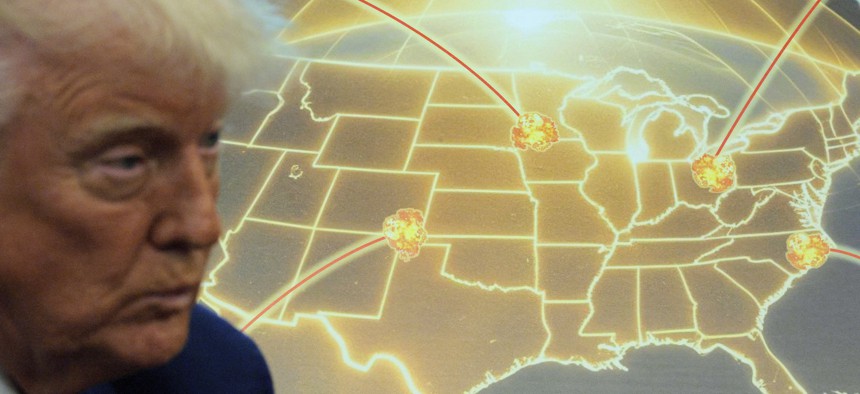
Donald Trump speaks in front of a map of his proposed Golden Dome missile-defense system in the White House on May 20, 2025. Getty Images / Chip Somodevilla



Trump's $18B Golden Dome request bets almost entirely on reconciliation
Relying on unusual budget maneuvers has the program on "unstable footing," one expert says.

Almost none of the $17.5 billion the White House is seeking in fiscal 2027 for the Golden Dome missile-defense project would come from the Defense Department budget, an Office of Management and Budget spokesperson confirmed to Defense One.
Less than $400 million would come from DOD's budget, with the rest from a proposed reconciliation bill, the second in as many years. Congress uses reconciliation, a special budgetary process that requires a simple majority to pass, to quickly enact mandatory spending legislation.
“The budget supports development of game-changing space-based missile defense sensors and interceptors, kinetic and non-kinetic missile defeat and defense capabilities and enabling technologies for a layered, next-generation homeland missile defense system,” the White House said in budget documents on Friday, adding that the administration is continuing “innovative program management and acquisition approaches to prudently employ taxpayer dollars.”
But defense experts said Golden Dome’s continued reliance on reconciliation legislation is a bad sign. Last year's One Big Beautiful Bill put $23 billion towards the administration’s signature defense project, but that's no guarantee of future funding, said Todd Harrison, an American Enterprise Institute senior fellow and defense budget expert.
“The whole program is on unstable footing,” Harrison said. “If they have not been able to move the main funding lines into the base budget, because reconciliation is highly unlikely to continue beyond FY27, then where does all the Golden Dome funding go in FY28?”
Overall, $350 billion of the $1.5-trillion 2027 defense-spending request would come from reconciliation funds, according to the White House’s budget documents. The administration's budget projections from 2028 through 2036 don’t showcase any additional mandatory funding, which would reduce the total defense spending.
Harrison said he was not surprised the Golden Dome-related reconciliation funds decreased from last year’s $23 billion to a little more than $17 billion in the proposed budget request.
“Golden Dome still has plenty of money sitting around waiting to be used,” he said. “So it's not too surprising that they're requesting a lesser amount.”
In January, lawmakers criticized the Defense Department for failing to provide budgetary details and justifications for the $23 billion in Golden Dome-related reconciliation funds. A Pentagon planning document obtained by Defense One last month showed that numerous Golden Dome-related funds had yet to be allocated.
But Space Force Gen. Michael Guetlein, Trump’s Golden Dome czar, has said that reconciliation funds are flowing.
“I have personally briefed all six committees numerous times on everything that we're doing on Golden Dome, to include the detailed costs of what Golden Dome is going to cost,” Guetlein told attendees at the McAleese Defense Programs Conference last month. “All of the funding for Golden Dome under reconciliation has flowed, and we've got a very close partnership with OMB and [the National Security Council] on execution of those funds.”
Gutelin also announced then that the program’s projected price tag had jumped $10 billion to $185 billion. Defense experts believe those costs will continue to rise—if not skyrocket.
The budget documents released Friday also acknowledge that Trump’s Golden Dome can't shoot down everything, a reality that physicists have asserted.
"The initiative's scope is to develop and mature a versatile, multi-layered defense system. The goal is to not create a 'perfect' defense, but to provide an increasingly effective shield that enhances the U.S. capability to deter attacks, disincentivize arms racing, and negotiate from a position of strength,” the budget document says. “For Fiscal Year 2027, the program will balance investments in next-generation technologies with the strengthening of existing foundational capabilities to improve near-term readiness and build for the future."
While Trump has not explicitly claimed the system would be flawless, he has described it in near-absolute terms. Last May, he said it would be able to intercept "very close to 100 percent" of missiles fired from anywhere in the world.