

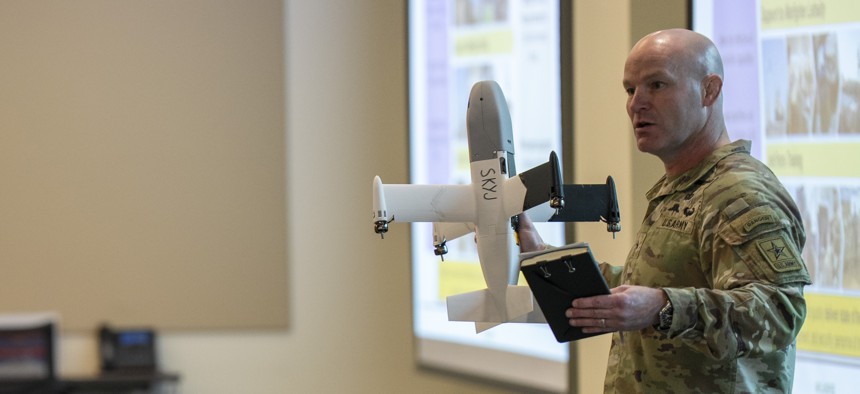
U.S. Army Brig. Gen. Matt Ross delivers remarks at a JIATF 401 Interagency Summit at the Mark Center, Alexandria Va., Nov. 25, 2025. U.S. Navy Petty Officer 1st Class Alexander Kubitza



The Pentagon wants a common network for its counter-drone systems
The Army-led task force wants candidates by early next year.

An Army-led task force is looking for one command-and-control system that can run any of the counter-unmanned aerial systems equipment that government agencies can buy through their online marketplace.
All of the different military installations running cUAS systems in one region, for example, need to be able to share data, the leader of Joint Interagency Task Force 401 told reporters on Friday, but the licenses for shared software are expensive.
“That new capability has got to plug in immediately to a common C2 framework, and so I'm excited about that. We plan to do that in the next 90 days,” said Brig. Gen. Matt Ross. “That's a huge lift, if you look at an enterprise-wide license—that usually takes over a year—but it will make a big difference for all of our installation commanders and for our services.”
Since the task force stood up in August, Ross and his team have been focused and testing and evaluating cUAS system components that can then go onto the marketplace, as well as standardizing training on the systems that will be used across the Defense Department, the Homeland Security Department and the FBI.
The FBI-run National Counter-UAS Center is now preparing law enforcement for the 2026 FIFA World Cup, which will see matches played in New York, Los Angeles, Houston and several other major U.S. cities.
Ross and his task force have been working closely with federal agencies to prepare for any drone threats during the World Cup, he said, “to make sure that they have an informed picture of the threat and understanding of what these systems can and cannot do, make sure that they have access to counter-UAS capability.”
DHS is well-equipped to deal with larger drone threats, Ross added, but his task force focuses on drones that weigh under 55 lbs. Not only is it inefficient to shoot them down with missiles, but the assumption is they’ll be used over populated areas that would take too much collateral damage with that strategy.
“I want to make sure that we have just as robust protection against Group 1 and Group 2 systems that are smaller and much more likely to be seen over a widely attended gathering, stadium, or a watch party specifically for the World Cup,” he said.
Army Secretary Dan Driscoll met with local law enforcement from the cities two weeks ago, Ross added, to talk about threats and ways to mitigate them.
“And that includes active patrolling, that includes putting out notices to the population about not bringing your drones to the game,” he said, as well as prosecuting anyone who does fly their drones to the fullest extent of the law.
Help us report on the future of national security. Contact Meghann Myers: mmyers@defenseone.com, meghannmyers.55 on Signal.
NEXT STORY: Special operators seek larger ranges for electronic warfare and drone development and training