

Courtesy Lockheed Martin

Air Force test pilots used tactical AI to evade a missile
A Skunk Works project pushed pilots to give artificial intelligence control in the cockpit.

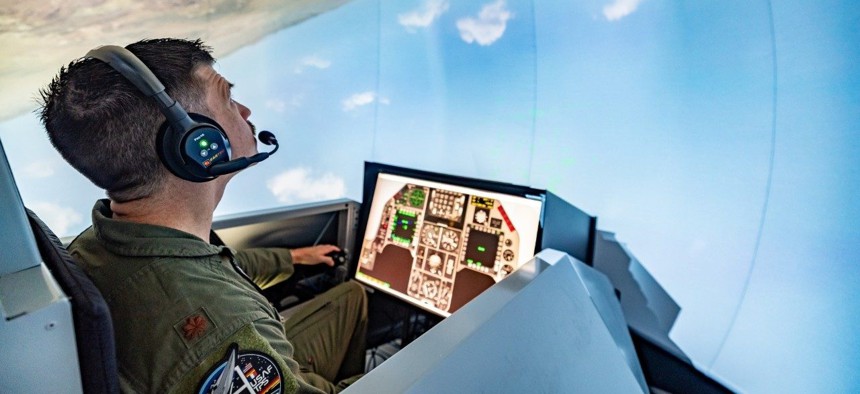
AURORA, Colorado—Air Force test pilots used artificial intelligence aboard an experimental fighter jet to successfully evade a simulated incoming missile, showcasing how the service’s aviators may rely on AI in a future fight.
Lockheed’s secretive Skunk Works research arm acknowledged the experiment Monday during the Air and Space Forces Association’s conference here. Late last year, test pilots at Edwards Air Force Base, California, received a simulated warning for an incoming surface-to-air missile while flying Lockheed’s experimental X-62A Vista jet. The onboard AI detected the missile and, without the pilot’s control, conducted an evasive maneuver.
“In this case, the missile signal or warning came in, the pilot didn't have to do anything, and the aircraft responded in a tactically appropriate way to keep the pilot alive and preserve the aircraft,” OJ Sanchez, Skunk Works’vice president and general manager, told reporters.
The test was called “Have Remy,” named for the rodent who helps a French chef cook by controlling his movements in the Disney film “Ratatouille.” The project also illustrates how AI tools might be used by the service’s fighter pilots. Distrust in AI among the general public still remains high, which experts have said may have broader national security implications.
Skunk Works’ project helped Air Force pilots train its AI models while simultaneously offering an opportunity for pilots to help develop and see how the technology may benefit them in future fights. Sanchez said the project showed how a fully autonomous unmanned aircraft could perform evasive maneuvers or be used as a feature in a suite of tools for aviators.
“Exercises like Have Remy are part of changing the way that we think about using AI agents in some of the most stressing human conditions, and I can't think of one more stressing than inside a fighter cockpit under attack.”
The X-62A Vista is a modified version of the F-16D Fighting Falcon, used to test automation and artificial intelligence. In 2024, Air Force Secretary Frank Kendall flew in an X-62A piloted by Shield AI’s software in a simulated dogfight with a manned F-16 fighter.
A September survey from the Pew Research Center detailed American skepticism and lack of trust in AI. Fifty percent of respondents said they’re more concerned than excited about the increased use of AI in daily life, and a majority of those surveyed also believe the technology will only make problem solving worse. Sanchez said experiments like “Have Remy” hope to break down those hesitations.
“We are going to have to get all of us as humans comfortable with working alongside artificial intelligence, and that takes trust, just like a human-to-human relationship,” Sanchez said.