

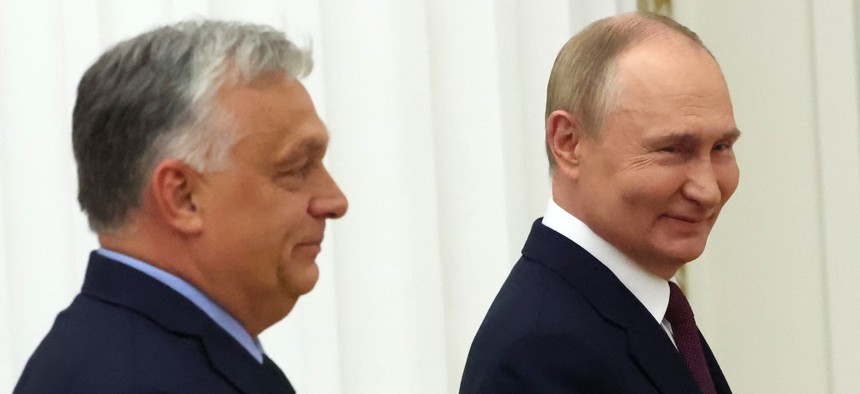
Russian President Vladimir Putin (R) and Hungarian Prime Minister Viktor Orban (L) smile while leaving their joint press conference at the Kremlin on July 5, 2024, in Moscow, Russia. Contributor / Getty Images



Orbán’s loss won’t stop Russian influence campaigns, but it shows they’re beatable
The Hungarian strongman’s electoral defeat exposes the growth, and limits, of Russian hybrid-warfare tactics.

The electoral defeat of Hungary’s Viktor Orbán dealt a blow to Russia’s foreign-influence operations—and illustrated how the Kremlin’s approach is changing. In the victory of the opposition-party candidate, other Western nations can draw lessons for confronting Russia’s continuing efforts.
Orbán was a key player in Vladimir Putin’s effort to weaken the European Union and its support for Ukraine. In February, the prime minister blocked a 90-million-euro loan that would have funded Ukrainian defense and civil infrastructure. His government also tried to block EU sanctions against Russian oil interests. In March, news broke of Orbán’s foreign minister collaborating with Russian foreign minister Sergey Lavrov to influence EU voting. Orbán himself accused Ukraine, without evidence, of planning to attack pipelines that carry fuel to Europe and even of plotting to send troops to his home. With Orbán’s loss, Putin loses a critical aide in his drive to establish a “sphere of influence” over a fragmented Europe.
Extraordinary efforts
Russian efforts to keep its Hungarian friend in power included a coordinated disinformation campaign launched in January, when false narratives began to spout from TikTok accounts and other social media accounts affiliated with a Russian group called Storm-1516. The first claimed that Tisza Party candidate Péter Magyar—Orbán’s main rival and ultimately the election’s winner—“used a humanitarian trip to Ukraine as cover to divert $16.7 million in European aid.” A second claimed that Magyar and others conspired with Ukraine to embezzle $30 million in international aid.
Researchers at Clemson University tracked the false narratives. Others included rumors of “reinstating military drafts, offending world leaders, and drug addiction,” the researchers write in a new research paper. “Storm-1516 targeted Hungary with 11 narratives identified for this report, several of which received thousands of reposts.”
Storm-1516 collaborates with Matryoshka, another Kremlin-backed group. Discovered in 2023 by French researchers monitoring Russian attacks on France’s national elections, Matryoshka “impersonates North American and European public figures and media outlets, including French ones” to spread disinformation about Ukraine and, sometimes, French politicians.
Storm-1516 and Matryoshka increased their Hungarian efforts in February and March. They baselessly accused Orbán detractors of child sex abuse. They accused Ukraine of attempting to foment a coup. In April, the Kremlin dispatched Putin’s First Deputy Chief of Staff, Sergei Kiriyenko, to coordinate online campaign strategy with the Orbán regime.
This drew calls for an investigation from the EU Commission, which said that the approach “is modeled on previous interference campaigns that Russia has rolled out in other countries, most recently Moldova. The interference team is reportedly deployed on behalf of Russia’s military intelligence service, the GRU, and operating out of the Russian embassy in Budapest.”
But Russia’s measures were muted compared to Orbán’s own party, Fidesz, which funded proxy groups such as the National Resistance Movement. Fidesz and its allies were the election cycle’s biggest creators of AI-generated content, according to the independent Hungarian monitor Lakmusz and the European Digital Media Observatory.
“Researchers attributed some targeted disinformation attacks in the Hungarian campaign to known Russian groups. However, their reach and impact so far have remained limited, at least compared to the disinformation” produced by the Orbán regime, EDMO wrote.
What this shows
All this illustrates changes in how Russia is waging digital influence warfare.
First, Russia is creating vastly more fake social-media accounts. The Clemson researchers found 36 TikTok accounts that purported to be legitimate marketing efforts, building up followings of 10,000 to 80,000 followers.
“Before January 2026, these accounts did not engage with or post Storm-1516 content. Since then, the accounts have shifted from commercial marketing and promotional content to posting political content aligned with Russian narratives,” the Clemson researchers write.
Such influence campaigns often work alongside physical hybrid-warfare tactics such as sabotage and political violence, Soufan Center observers wrote in March.
Russia is also working to put a local face on its influence efforts. The Kremlin engages a friendly politician in a target country to take the lead, then boosts his or her message with fake accounts and a growing network of Kremlin-paid influencers.
“By leveraging influencers and the trust they have from existing communities, Russia can engage in focused messaging targeting specific communities with narratives that those communities may already be inclined to believe,” the Clemson researchers write.
When such politicians win, they erect institutional obstacles to prevent opposing candidates from displacing them. The Orbán government “had worked on every district, just crafting it to make it perfect for its own strengths and weaknesses. They had almost total control of radio, television and media. They were using massive, massive state resources for their own political purposes,” Thomas Carothers, director of Carnegie's Democracy, Conflict, and Governance Program at the Carnegie Endowment, said on a podcast this week. So Magyar “was going against, you know, it looked like every possible obstacle.”
U.S. President Donald Trump and Vice President J.D. Vance have been open boosters of Orbán and his tactics. Vance campaigned for Orbán—even repeating a Matryoshka false claim: that Ukraine, not Russia, was interfering in Hungary’s election.
Russian efforts in Hungary will continue.
“Even without Viktor Orbán, Fidesz controls roughly 80 percent of Hungary's state media landscape and remains a willing partner. If anything, Russian operations will be even more network-driven, leveraging political allies and entrenched media infrastructure to sustain anti-Ukraine narratives and erode trust in the EU,” said former Assistant Secretary of State for Intelligence and Research Ellen McCarthy who now leads the Trust in Media Cooperative.
They will also find new targets outside of Hungary.
“Increasingly, they are targeting regional elections, trying to influence countries within their sphere of influence. We already know who their next target is: Armenia,” which has elections coming up in June, said Darren Linvill, one of the authors of the Clemson paper and co-director of the Watt Family Innovation Center Media Forensics Hub. Linvill pointed to several examples of new false social media accounts that he says were set up he says to target those elections. “From Russia's perspective, this is self-evidently worth it, largely because these efforts are cheap to produce and have very little downside. In the current political environment one could even say there has been no downside.”
In their March report, the Soufan Center says Russia’s ultimate hybrid-warfare goal isn’t actually to help one candidate over another, but to undermine democratic societies
“This strategy drains the financial resources, military capabilities, and political bandwidth of countries supporting Ukraine, or withdrawing from its traditional sphere of influence, while providing a testing ground to refine tactics for potential future conflict with NATO. Erode the guardrails that make democracies resistant to interference by exploiting pre-existing societal schisms, undermining trust in institutions and keeping populations polarized and confused.”
Magyar’s win, however, also offers a blueprint for beating Russian and Russian-aligned election interference. Magyar was particularly gifted at social-media campaigning, visiting more than 700 cities and towns across Hungary and continuously putting out social-media content that was watchable and nimble, said Carothers, a part-time resident of Hungary.
“He'd walk into a public building where the elevators were broken, and stand in a broken elevator and go, 'Why does this elevator not work? Why does nothing work in this country?' People loved them. Very clever social media campaign.”
The opposition candidate was also willing to face Russian disinformation head-on and call out specific attacks even before they hit the internet. On March 10, Magyar took to Facebook to warn of a new AI-enabled disinformation campaign targeting him.
“In the coming days, the Fidesz party, together with Russian services, will launch a smear and disinformation campaign that has already been tested in Moldova, primarily on social media, particularly on TikTok,” he said.
Perhaps the biggest factor that drove an election turnout above 80 percent was the simple fact that Hungarians are increasingly sensitive to Russia’s growing attacks on democracy, wrote Matt Steinglass, the Europe editor for The Economist. “People were much more concerned than we had thought about the country's shift towards Russia. They were concerned about leaving the European Union. More and more news started coming out about how Russia had sent social media operatives to Budapest to try to help Fidesz retain power.”
That is, perhaps, a warning for other politicians who saw Orbán as a model.