

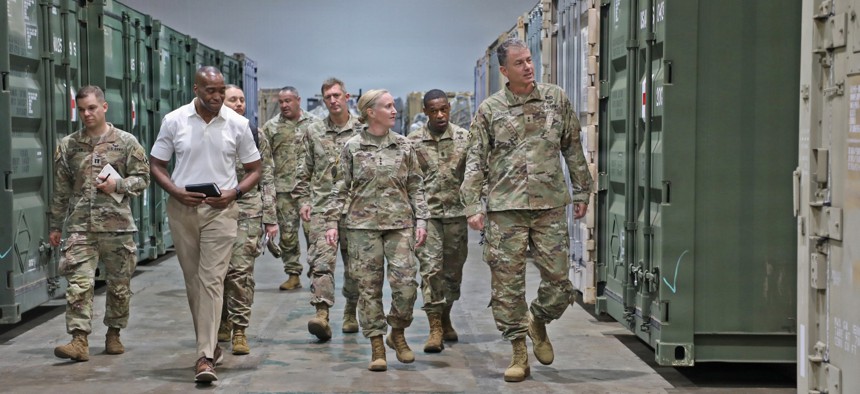
Maj. Gen. Gavin Gardner, commander of the 8th Theater Sustainment Command, hosts Lt. Gen. Michelle Donahue, the deputy chief of staff for Army logistics, during a tour the Joint Theater Distribution Center, April 12, 2026, in Agila, Philippines. U.S. Army / Master Sgt. P. Behringer



The military says it’s ready to ‘fight tonight’ in the Pacific. Can it sustain that fight?
“We cannot win if our supply lines are 5,000 miles long,” says U.S. Forces Korea commander.

WAIKIKI, Hawaii—Having the “right stuff at the right place at the right time” in the Pacific theater is “a little bit of a maths problem,” says U.S. Indo-Pacific Command’s strategy director for logistics and engineering.
“Hawaii is 3,000 miles from the West Coast. Guam is 5,000 miles from Hawaii, and the first island chain”—which includes Japan, Taiwan, and the Philippines—“is 1,500 miles from Guam,” Brig. Gen. Jim Bliss of the New Zealand Army said this month during the Indo-Pacific Security Forum.
It’s “a vast ocean,” with “very, very little in the way of logistics nodes on land forward available to be used,” Bliss said.
If troops and materiel aren’t “forward when the fighting starts,” it will be difficult to get them there in time, he said.
It’s a problem that preoccupied many U.S. military leaders in the region.
“Here in the Indo-Pacific, a robust domestic base is a hollow shell if we cannot project that power across the tyranny of distance,” said Gen. Xavier Brunson, the commander of U.S. Forces Korea, during a keynote speech at AUSA’s Land Forces Pacific conference. “We cannot win if our supply lines are 5,000 miles long.”The U.S. Army’s “delivers foundational sustainment capabilities to the entire joint force. And I’m fervent in my belief that nobody knows or senses or feels viscerally the scale of sustainment than our nation’s Army,” Indo-Pacific commander leader Adm. Samuel Paparo said at LANPAC.
Maj. Gen. Gavin Gardner, commander of the Army’s 8th Theater Sustainment Command, reiterated that point later in the conference. Pre-positioning equipment forward, with partners like the Defense Logistics Agency and Army Materiel Command, and building what the Army calls joint interior lines, “quite frankly, demonstrates our ability to overcome that 7,000-mile distance” from the continental United States to “where we think we need to operate.”
Noting that he’d “rather get a root canal” than have to import things into Australia, Gardner said the Army has been prepositioning equipment there on a significant scale.
Still, he said, the issue is not just “storage and distribution,” it’s also about the ability to repair things when they break—without sending them back to the continental United States.
“We don’t want to” send it back, Gardner said. “We want to repair it forward. We want to repair it forward now, in what I call ‘competition’” so it’s ready when a conflict or crisis emerges.
In the past, he said, the unit had to send a broken Army watercraft to the U.S. West Coast. But because of expanded contracts, “now, I can fix it in South Korea. I could fix it in Japan. I could fix it in the Philippines. I could fix it in Australia. I could fix it in Singapore.
“That may sound like a small thing, but you know, that towing of a ship—two years in a row—all the way back from Australia—two years in a row—it takes a long time. That’s a 30-day sail in order to get it back,” he said, referring to the annual Talisman Sabre exercise.
Such a delay is untenable, USFK’s Brunson said.
“We cannot shuttle broken equipment across an ocean for repair while an adversary evolves on our doorstep,” he said.
On the Korean peninsula, Brunson said, “we’re already fixing forward and improving the concept.” Korean dry docks have “successfully overhauled” three U.S. ships, with two more in the queue. And by “leveraging special repair authority and weaponizing advanced manufacturing, we’re transforming our theater blueprint into a permanent deterrent.”
Resilience “is no longer a support function, but has to be a warfighting function,” said Marine Maj. Gen. George Rowell, INDOPACOM’s director of strategic planning and policy. “It means sustaining combat power, command and control, and logistics, and being able to take hits in a degraded environment.”
The way forward, Rowell said, is to “supercharge our defense industrial base,” and “innovate with non-traditional primes.”
“China possesses over 50 percent of the global commercial shipbuilding capacity, while the U.S. has about 0.1 percent, making it imperative that we accelerate capacity through both established and emerging industrial partners.”
A day after Rowell’s keynote at the Indo-Pacific Security Forum, Paparo told the audience at LANPAC that Allied forces won World War II “because industry built combat power at scale, a scale that the Axis powers could never match. And American sustainment delivered, from the factory floor to the fighting positions across the globe.”
Now, Paparo said, “we set the theater,” by posturing forces and pre-positioning sustainment, and creating “a network of distribution centers” throughout the Indo-Pacific.
But, he said, “we’ve got to be smart about how and where you’re pre-positioning ammunition stocks, because in this 21st-century warfare environment, you must [protect] those things that can’t be moved, and you must always be moving the things that you can.”
Marine Maj. Gen. Matthew Mowery, deputy commander of Marine Corps Forces Pacific, said the Marines set a goal of being able to sustain their own forces for 45 days within the first island chain. But he can’t build up an “iron mountain” of equipment and supplies.
And ultimately, Mowery said, “If we think that…if and when deterrence fails, and a crisis goes to conflict, we think we’re going to have 45 days to bring in, you know, all of our equipment sets and bring those forces in—we have not been kidding ourselves, but we would be kidding ourselves. If you don’t have those forces here when the shooting starts, you’d better plan to live without them.”
Maj. Gen. Ash Collingburn, commander of the Australian army’s 1st Division, echoed Mowery later that week.
“If it’s not forward when the fighting starts, then it’s really hard to get” needed supplies and people forward, he said. “I see sustainment as the key challenge in the theater—across time, across distance, across contested lines of communication. If we want to campaign at the edge, we need to be able to sustain.”