

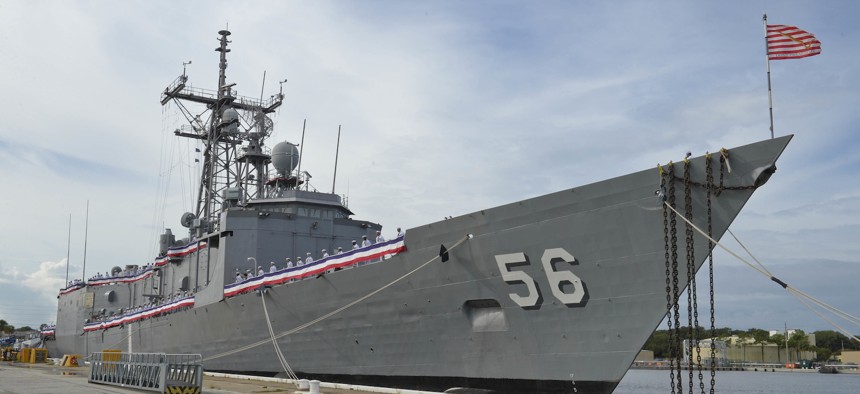
Sailors man the rails of the guided-missile frigate USS Simpson during its decommissioning ceremony in 2015. US Navy / Mass Communication Specialist 3rd Class Timothy Schumaker



The Navy used drones to sink a retired warship
Lessons from the SINKEX are shaping the service’s plans to buy and fight.

A U.S. warship used aerial and maritime drones to help sink a decommissioned frigate last fall, Fourth Fleet officials have confirmed, adding that the experience is now shaping how the Navy will go into future battles.
On or about Sept. 28, somewhere in the Fourth Fleet’s slice of the Atlantic Ocean, the littoral combat ship Cooperstown launched four unmanned aerial vehicles and one unmanned surface vessel against the former USS Simpson, a Perry-class guided missile frigate that was until recently the last modern U.S. Navy vessel to have sunk an enemy warship.
The robot formation executed three kinetic strikes against the Simpson as part of live-fire attacks that put the hull on the bottom and capped the weekslong, multinational UNITAS 2026 exercise.
Neither the drones’ participation in the SINKEX nor the identity of the warship that went to its watery grave appear to have been previously confirmed.
The drone attack was largely coordinated by personnel ashore, not aboard the relatively lightly crewed Cooperstown, a Fourth Fleet spokesperson said.
“The exercise was primarily commanded from the Maritime Operations Center, MOC, ashore, with some senior staff elements afloat. The Robotics Operations Coordinator was part of the element ashore at the MOC, monitoring the status of each [automated unmanned system] and event serials in which they participated,” the spokesperson said via email. “We also conducted coordinated anti-submarine warfare against a diesel submarine using long-dwell USVs with acoustic capability.”
The Navy is refining its approach to assessing and buying unmanned surface vessels as it works to integrate drones across domains into its fighting structure.
Could data centers at sea set drones free?
Situational awareness experiments were also conducted aboard Cooperstown, such as using flying drones to collect targeting data. These were underpinned by a “deployable data center” transported from Mayport, Florida, set up in Norfolk, Virginia, and ultimately put aboard the littoral combat ship. The data center, provided by Armada, was equipped with AI and machine-learning tech, including computer vision and tested maritime domain awareness technologies. It was the first time the company’s product was tested at sea.
Logistics delays, including a hurricane, kept the devices from processing much of the exercise data, but nevertheless provided “an excellent proof of concept,” the Navy spokesperson said. “The team engineered electrical and data connectivity in record time, and the ship transported the DDC on the next leg of its deployment, providing edge computing power at sea.”
Lawmakers have proposed to spend $10 million for “deployable data centers that deliver remote and resilient edge computing” under Navy experiments and demonstrations in a draft 2027 defense policy bill.
During the exercise, the Cooperstown launched four aerial drones, including a medium-sized Group 3 UAV whose collection could be used to train AI targeting models in a crowded maritime environment.
“The UAV launched from the [robotic and autonomous systems] mothership and captured imagery of [more than 20] naval vessels during the multinational exercise,” the Fourth Fleet spokesperson said. “With very few global opportunities to capture data on dozens of different classes of ship in close formation, the traffic density helped train and improve the AI model significantly more quickly than multiple individual flights in less complex environments.”
Each aerial drone flew at least once and flights were planned around known and weather-related limitations—an incoming hurricane shortened the exercise. But the hope is to increase that in the future.
“There were limitations on when UAVs could fly in order to maintain safety of flight. Exercise event schedules, ship maneuvering, manned aircraft flights, gunnery exercises, and competing demands for flight deck space all impacted planned UAV operations,” the spokesperson said, noting that some flights were cut short for safety reasons revolving around drones operating near manned aircraft.
“The commander prioritized safety and successful exercise execution and temporarily paused most UAV flights for a few days, pending engineering analysis of a particular suspected communications interference issue.”
Overall, the Navy said, the robot mothership was a success, particularly with the pre-planning for how the systems would be used and the infrastructure, such as battery power and hangar space.
But there’s always room for improvement, including more ship connectivity and someone to lead the robots. There wasn’t an onboard robotics specialist during the exercise—something that could change.
“For future mothership deployments, a dedicated robotics officer in charge or liaison could be beneficial,” the spokesperson said. “Although each team knew their individual [tasks], we will mandate more comprehensive mission briefs with the ship’s operations staff.”