

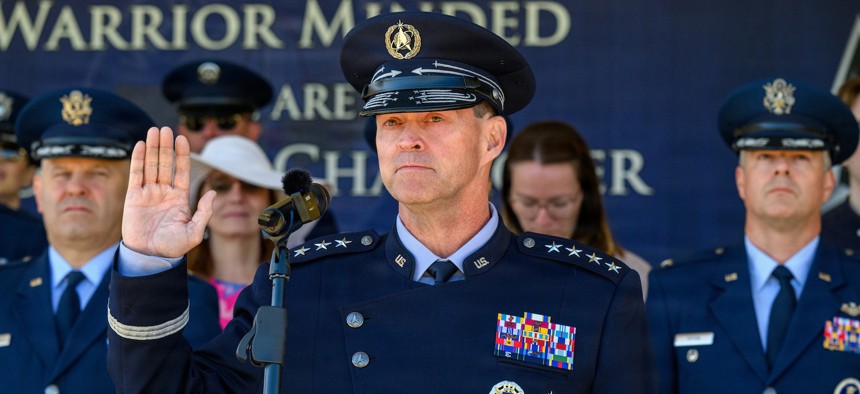
Chief of Space Operations Gen. Chance Saltzman administers the oath of office during the Officer Training School Class 26-08 graduation ceremony, marking the commissioning of the Air Force’s newest officers. Air University / Brian Krause



Space Force’s 2040 vision: a larger force to contend with larger Chinese, Russian threats
Officials speculate there could be 30,000 US satellites—more than twice as many as today.

COLORADO SPRINGS, Colo. — The next 15 years will likely see potential adversaries crank up their space and counter-space capabilities, so the Space Force needs more people and money, the service’s chief said as he rolled out two long-awaited policy documents on Wednesday.
Together, “Objective Force 2040” and “Future Operating Environment 2040” offer “a conceptual view of a future where our space superiority efforts must contend with new technologies, new threats, new missions and new ways of war,” Gen. Chance Saltzman said during his keynote address to the Space Symposium conference here. “It will serve as a point of departure and a catalyst for the growth and change that the future of space war fighting will demand.”
Plans for the Objective Force document were announced in early 2025 and for the Operating Environment document in September; both were expected by year’s end. Saltzman said the delays were “my fault” and that he was particular about the wide-ranging ambitions and vision the documents painted for the service. Some of the findings have already privately been briefed to various government and military organizations.
The public release coincides with a record-breaking 2027 budget request for the service and recent calls to double the number of guardians over the next decade. The public rollout also marked one of Salzman’s last major appearances before his retirement later this year.
Threats through 2040
The operating-environment document identifies China, and to a lesser extent Russia, as the service’s main threats.
The service predicts China will develop the “means and desire to use integrated, AI-enabled space-ground operations on a global scale,” according to the document.
The service predicts China may make large investments in sophisticated intelligence systems, proliferated low-Earth-orbit constellations for communication, sophisticated counterspace weapons, maneuverable space assets, and human-machine teaming for future operations.
Russia will likely look to “asymmetric counterspace capabilities” rather than “pursue space power parity” with NATO and the United States by 2040, the document says.
Space Force planners predict Russia will aggressively pursue technologies to level the playing field, such as a nuclear anti-satellite weapon that they won’t be afraid to use.
“Russia has the lowest threshold for nuclear weapons use in the world, according to its public doctrine,” the document says. “Though the use of space-based nuclear weapons is not explicitly mentioned, there is increasing concern that Russia is developing a nuclear ASAT.”
By 2040, Space Force officials speculate, U.S. government and commercial entities will operate upwards of 30,000 satellites. There are about 12,000 operational U.S. satellites in orbit now, according to the American Enterprise Institute’s space data navigator tool.
The document estimates that China will have roughly 21,000 satellites by then, up from 1,602, by AEI’s count, while Russia will have about 1,500, up from 356.
The Space Force documents diverge somewhat from the new National Defense Strategy, including by stating that China and Russia are likely to be the main threats, and that U.S. allies and partners will be key to staving them off.
“Commitments among established allies and partners will endure. NATO, Australia, the United Kingdom, and the United States (AUKUS), as well as the U.S.–Japan alliance and the U.S.–South Korea alliance, along with enduring U.S. partnerships, will remain the backbone of Western deterrence,” the document reads. “Adversarial alignment among Russia, China, Iran, and North Korea will continue informally, but without the creation of a formal ‘anti-U.S.’ bloc or new league of treaty based alliances.”
The operating-environment document also speculates that there will be “no major wars fundamentally altering the state system” such as a U.S.-China clash over Taiwan or a NATO-Russia escalation in Ukraine before 2040.
“Conflicts and crises may arise and intensify, but the existing major frontiers and the global balance of power will be preserved,” it says. “The world remains fraught with rivalry and limited conflict, but it avoids systemic breakdown or large-scale territorial revisionism.”
Saltzman told reporters the document was not intended to align with the National Defense Strategy, but prompt thought among the service about what it faces in the future.
“There is no intent to square this with a strategy, because it is not a strategy,” Saltzman said. “It is simply one vision, one conceptualization of what the future could be.”
Tomorrow’s force
To counter those threats, the Space Force hopes to expand and reorganize its number of guardians and missions.
“The Space Force will require significant additional manpower and specialized expertise to generate space control forces able to conduct sustained operations at a global scale,” the Operational Force document reads. “In practice, this will result in new deltas and squadrons as well as new types of Squadrons focused on targeting, command and control, and battle damage assessment.
The service also believes its orbital, electromagnetic and cyberspace warfare missions “will only become more vital,” the document reads, and would like to see them grow.
In addition to taking on additional mission sets, the service also expects that “existing units must realign to organize around platforms rather than around effects” as a way to provide more rapidly deployable and mobile forces.
While those ambitious plans will require more manpower and money, there are some mission areas that could see a decrease in some roles. Satellite control units, for example, could see a “net decrease in dedicated personnel” as it turns to more automated services to reduce crew responsibilities.
To meet the demand for a growing list of missions, the service points out it will likely need to rely on allies and artificial intelligence to meet those emerging threats.
“The Space Force of 2040 will be fundamentally different from the service of today,” the document reads. “It will center on proliferated, resilient architectures that integrate military, commercial, and allied capabilities into a hybrid warfighting system. It will operate at machine speed, leveraging artificial intelligence and autonomous systems while maintaining the primacy of human judgment for critical decisions.”
The Objective Force document will have classified and unclassified versions, and the service plans to publicize new changes and ideas as the service’s vision evolves from one administration to the next.
“To the maximum extent possible, the Space Force will publicly release an unclassified Objective Force every five years, providing a high-level summary of a much deeper body of conceptual and analytical work,” the document reads.
Saltzman’s swan song
Saltzman’s keynote address and roundtable with reporters on Wednesday marks one of his last major public engagements as the service’s top uniformed leader.
His tenure has been defined by a push for the service to embrace a warfighting mindset and to adopt new missions. It’s also grown from a budget of $26 billion to nearly $72 billion over the past three years and expanded to nearly 11,000 service members today.
The Space Force has also seen more public recognition for its role in joint operations.
Air Force Gen. Dan Caine, the Joint Chiefs chairman, and Navy Adm. Brad Cooper, the head of U.S. Central Command, have both highlighted the role that space and guardians played in Iran and Venezuela, describing the service’s space effects as critical first wave in operations which quickly established “space superiority.”
Saltzman was confirmed to the four-year chief of space operations position in the fall of 2022. On Wednesday, the general said he was retiring but declined to provide a date for when he’ll leave his role.
“I'm not sad,” Saltzman said. “This is so exciting…We're starting to marry up resourcing and processes and guardian talent; the joint force is recognizing how important this is. I think our messaging is getting through.”