

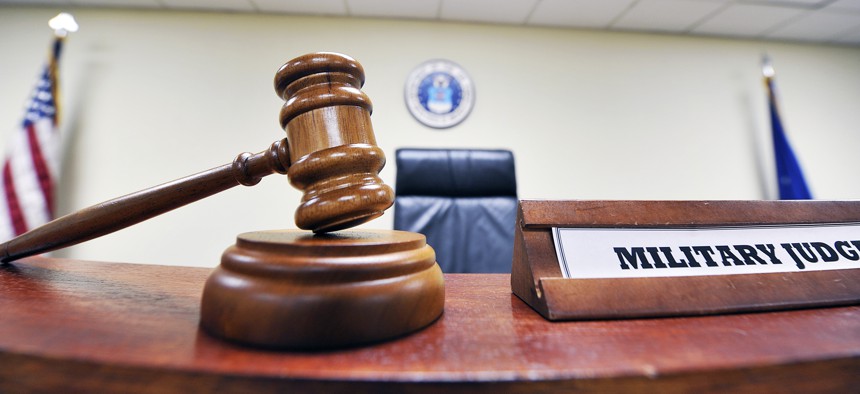
A view of the legal office of Kadena Air Base in Japan. U.S. Air Force / Naoto Anazawa


Hegseth memo calls for sweeping, open-ended review of Pentagon's legal system
It’s the secretary's latest unusual move toward DOD’s military and civilian lawyers.

Defense Secretary Pete Hegseth, who last year gutted a Congressionally-created panel that oversaw his department’s legal community, is standing up a new one with a broader purview.
Hegseth’s latest unusual move comes three months after he ordered a “ruthless” review of military lawyers that some saw as an attempt to evade accountability.
On Monday, the secretary released a video in which he said the new panel would conduct an "ongoing, long-term, department-wide review of all aspects of the military legal system as it affects our warriors.”
Hegseth ordered up the panel in a May 8 memo to service secretaries, the Joint Chiefs staff, the military’s criminal investigation divisions, and the uniformed and civilian legal offices.
The Defense Department declined to provide the memo. Defense One has reviewed the two-page document.
“The [panel] will operate on a sustained basis rather than producing a single end-of-review report,” Hegseth wrote in the memo. “It will deliver interim reports and recommendations on specific issues as they are completed, with periodic updates to me. These reports will drive immediate reforms to cut unnecessary bureaucracy, strengthen training and organization, refine culture, and professionalize military justice implementation and command advice.”
Earl Matthews, the Defense Department’s general counsel, is to convene the panel.
In his memo, Hegseth wrote that the review is “not about diminishing the essential role of our uniformed and civilian legal experts” but to provide support for “effective legal advice that upholds the rule of law while enabling maximum mission effectiveness and decisive action.”
Current and former military lawyers told Defense One that they’re skeptical.
Steve Lepper, a retired Air Force lawyer and a member of a group of former JAGs that has spoken out about the administration’s military actions, said creating the panel appears to be part of a power grab for legal oversight of the armed services.
“What the Pentagon here is doing is, they're basically wrestling from Congress this oversight of the JAG Corps and substituting his own panel for the panel they dismantled,” Lepper said.
Hegseth’s memo suggests that earlier reviews of the military justice system fell short.
“Previous assessments, including statutory reviews, GAO reports, and recent efforts to align legal functions, have provided valuable insights,” he wrote. “However, a more comprehensive and sustained examination is now required to ensure the system fully supports our warfighters, restores trust across the force, and delivers the legal support our commanders and troops deserve in an era of great-power competition.”
The new panel is Hegseth’s latest unusual move regarding the department’s legal community. In his first weeks on the job, he fired the Army, Navy, and Air Force’s top lawyers, claiming they were “roadblocks to orders that are given by a commander in chief.” The next month, he commissioned his personal lawyer into the Navy’s JAG corps.
In March, Defense One first reported on the contents of a memo that ordered a split of duties between the Judge Advocate Generals and the general counsel offices, which raised fears among military lawyers and other experts that it would gut the legal oversight of the Trump administration’s actions.
A Defense Department spokesperson said Hegseth’s latest memo differsfrom his March directive but declined to say how or to describe findings produced in response to the earlier memo.
At least one of the service branches submitted its plan last month to deconflict duties between the uniformed and civilian to the Pentagon, the defense legal insider told Defense One.
Those lawyers that haven’t been ousted or removed from the services or civilian offices have been stretched thin. In the Trump administration's first year, it greenlit the temporary assignment of more than 600 JAGs to work for the Justice Department as immigration judges. Earlier this year, Defense One reported that the administration had temporarily assigned dozens of military lawyers as federal prosecutors to support law-enforcement surges in Minneapolis and other cities.
Yet Hegseth, who authorized the assignments, complained in March that “military lawyers are sometimes stuck doing civilian side work” and called it evidence that the legal shops are being mismanaged.
This week’s announcement comes amid a war on Iran that some experts have argued is illegal, and during international and domestic missions that have been criticized by former JAGs.
Lepper said it appears that the guidance of uniformed lawyers has been pushed aside during those operations.
“What I'm hearing from other JAGs is that they're simply not being asked to provide input on the legal opinions that are being handed down by the executive branch that apply to things like the Iran conflict and the boat strikes,” he said.
Lepper said current military lawyers have told him that most legal opinions are being written by the White House Office of Legal Counsel, then handed to JAGs for implementation.
“It's one thing not to consult JAGs, or not to give JAGs an opportunity to voice their views on the legal opinions that are being rendered by the executive branch,” he said. “It's another now again to put them under a microscope and suggest that somehow they're not doing their jobs.”