

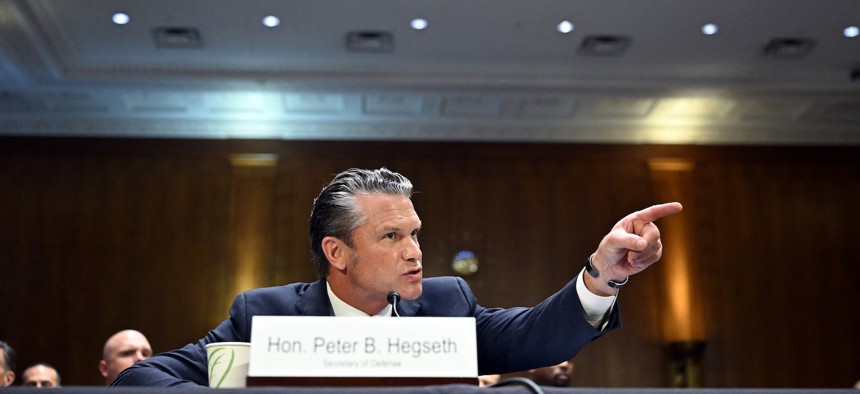
Defense Secretary Pete Hegseth testifies during a Senate Committee on Appropriations hearing in Washington, DC, on July 21, 2026. Alex WROBLEWSKI / AFP via Getty Images



Hegseth’s conflicting statements, evasions drain lawmakers’ patience, support
As public opinion on Trump’s Iran war collapses, senators express growing frustration at shifting White House rationales, missing strategy.

Given a rare chance to press top Pentagon leaders, senators from both parties on Tuesday pleaded with Defense Secretary Pete Hegseth to outline a strategy for the U.S. war on Iran or simply to defend his previous statements about it. Hegseth responded at times combatively or evasively. The meeting highlighted growing frustration over the costly war and the Trump administration’s multiple and shifting rationales for it—all of which appear to be reducing lawmakers’ appetite for the White House’s unprecedented $1.5 trillion defense-spending request.
Lawmakers are not the only ones frustrated with Operation Epic Fury. Last week, 68 percent of the public said the war was “not worth fighting,” according to an Ipsos poll. Wednesday brought fresh numbers from Politico showing that just one-third of self-identified MAGA voters approve of the war—a 13-point drop in two months.
At the hearing, Sen. Chris Coons, D-Del., said that the drops don’t reflect differences in concern about a potential Iranian nuclear arsenal, but rather disapproval of how the White House has gone about trying to prevent it.
“This radical Iranian regime should never possess a nuclear weapon. I think we agree on all of these core basic points,” Coons said. “I think your first strategic mistake was to not consult the American people and Congress and make a clear case for the reasons behind this war. There have been many, lots offered.”
Perhaps the most telling portion of the hearing came toward the end, when Sen. Jon Ossoff, D-Ga., read Hegseth’s previous public statements back to him verbatim and then asked Hegseth to recommit to the statement.
Ossoff: “You said, quote, ‘Operation Epic Fury was a historic and overwhelming victory.’ You said Iran's military had been rendered, quote, ‘combat-ineffective for years to come,’ and you stated we had, quote, ‘achieved every single objective.’ Were those accurate statements?”
Hegseth answered that U.S. strikes had decimated Iran’s Air Force, Navy, and industrial base, but acknowledged that the country was still developing and launching drones and missiles. “So we never expected they would stop having capabilities to shoot. The question is at scale against opponents like the United States of America.”
Ossoff repeated the question, seeking a declarative yes or no that did not come. He continued, “On March 8, day nine of the war, on 60 Minutes, you assured the American people of Iranian surrender. Does that remain your prediction?”
Hegseth replied, “Iran will never have a nuclear weapon to threaten the United States of America. That has been the objective, and it remains so.”
Sen. Kirsten Gillibrand, D-N.Y., put the consistency and credibility issue to Hegseth more bluntly.
“The reason why [voters] are so upset with you and this administration is because the words you have used in the past don't add up,” she said. “About Iran, specifically, you said that we had obliterated, quote unquote, Iran's ability to create nuclear weapons. The president made the same claim. Yet eight months later, in 2026, the president launched an act of war, claiming Iran was within two weeks of having a weapon. So when you say two very different things, the American people don't know who to believe or what to believe.”
She went on to reframe the issue in terms of growing economic uncertainty among voters, merely seeking consistent answers as they are asked to make sacrifices. “They just know they can't afford their health care; they can't afford their food; they can't afford housing, and our farmers are continuing to suffer. So, which is true? Was it obliterated or wasn't it?”
Even some staunch supporters of President Trump and his agenda lost patience with Hegseth’s inability to articulate a clear goal for ending the war and the consequences of the United States leaving it before a favorable outcome could be reached.
One such Trump ally, Sen. John Kennedy, R-La., asked Hegseth whether Iran would be able to restart its nuclear program if the United States concludes operations too soon.
Without providing a clear yes or no, Hegseth answered that Iran had not given up its nuclear ambitions even though their nuclear sites had been obliterated.
Kennedy interrupted the response with a shout: “We need straight answers!”
That lack of straight answers is hurting not only the White House but also senators' ability to meet the administration’s historic budget request.
Budgeting is very much a part of the discussion among the most loyal members of the President’s voting base. Some 37 percent of self-identified MAGA voters now say they would support the war only if it does not increase costs, according to Wednesday’s Politico poll, a number up from 29 percent in May.
Coons observed broad bipartisan support for the budget’s main pillars: $21 billion to sustain forward-deployed forces, pay increases, and other readiness items; $46 billion to replace munitions stockpiles, develop new supply lines for solid rocket motors, and new counter-drone defenses, and others. There is enthusiasm for the Defense Department’s acquisition reform and bringing in new technology players. But lawmakers had little insight into how the White House was spending funds that Congress had already given it to meet those goals.
“Mr. Secretary, your question says: Without these supplemental funds, we will face critical shortfalls that threaten our ability to pay our service members and sustain global operations without disruption. You've been asked repeatedly—there's $75 billion appropriated but unobligated—can we really not avoid critical short-term shortfalls? What does that mean about the budget management within the department in terms of unexpected and unbudgeted wars, first, Operation Southern Spear and then Operation Epic Fury?”
Hegseth answered that the funds previously allocated under the Big Beautiful Bill would be spent by September. That the U.S. military was receiving everything it required “in spades.” The $1.5 trillion budget request “and any additional funding that comes,” was related to efforts to modernize the force.
Coons observed that those were “Two quite different things. A $1.5 trillion base budget request and a now $67 billion supplemental.” The September date was “news to him.”
At various points, lawmakers turned their attention to Gen. Dan Caine, the chairman of the Joint Chiefs, to make the Pentagon’s case where Hegseth could not. They lavished credit and praise on Caine for carrying out U.S. policy, however confusing they found that policy to be, and then called on him to affirm that China, Russia, and Iran were working together.
“There is no doubt that they are aligning,” Caine responded.He also compared the giant 2027 budget request to the work done by George C. Marshall to mobilize the U.S. military for World War II, then to transform the War Department into what would become the postwar Defense Department.
“I view this as a future investment to buy down risk, similar to what I said Marshall fought through in those heady days in 1940, where the need to invest capital early to deliver scale is an opportunity that I hope we don't miss.”