

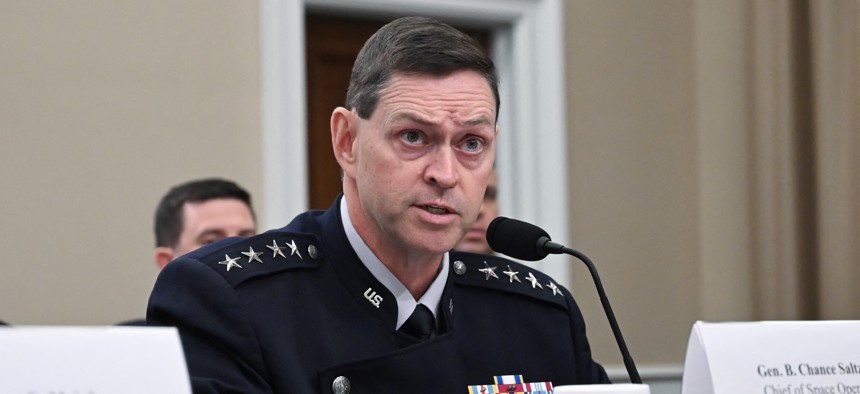
Chief of Space Operations Gen. Chance Saltzman testifies at a House budget hearing in Washington, D.C., on April 30, 2026. Alex WROBLEWSKI / AFP via Getty Images



Space Force faces budget uncertainty as leader plans exit next month
Gen. Chance Saltzman sets his retirement as the service’s top budget priorities face cuts, scrutiny.

LONDON—The U.S. Space Force’s soon-to-be retired top officer urged support for his service’s programs, the same day as House lawmakers said they would approve only a fraction of the funds the Trump administration requested for major space efforts.
Space Force Gen. Chance Saltzman, the chief of space operations, told international military leaders at the Global Air and Space Chiefs’ Conference here on Tuesday that space is, undoubtedly, a warfighting domain. Invoking American poet Robert Frost, he said, “We must frame our choices around how to have military advantage, and for better or worse, the path we choose will make all the difference.”
Saltzman said during his speech that he will retire next month. The White House has tapped Lt. Gen. Douglas Schiess to replace him, as first reported by Defense One in April. Schiess is scheduled to appear for a confirmation hearing by the Senate Armed Services Committee on Thursday.
But elsewhere on Capitol Hill, lawmakers say they will not fully comply with the Trump administration’s request to fund important priorities through reconciliation—a partisan-controlled budget maneuver rarely used for defense spending before last year. That could leave the Space Force far short of the money it wants.
The White House has asked Congress for $1.15 trillion through the normal defense-budget process plus another $350 billion through reconciliation. The latter amount would fund major Space Force programs, such as the Air Moving Target Indicator and the space data network, and the vast majority of funds for the Golden Dome missile defense program.
On Wednesday, Republican House leaders said they would support a reconciliation bill of just $60 billion.
Saltzman didn’t say whether a smaller reconciliation package would harm the service, but said during a roundtable interview on Wednesday that “I stand behind” the service’s budget request and added it was “a dramatic increase in resourcing requests for what I think are vital” space capabilities.
“I think these things are always negotiations between the executive and the legislature. That's the way the system works,” Saltzman said. “I stand behind the requirements and the resources that we requested, and now over to Congress to determine what that appropriation looks like.”
During his speech, Saltzman told the military leaders in the room that they have to be steadfast during political division.
“In the hyper-political environment we find ourselves, with partisan politics created divisions between a multitude of stakeholders, I remind myself that military institutions in our democracies, particularly military leadership, serves as the ballast in the ship. While it may feel like the ballast slows progress as the ship of state attempts to quickly move towards its goals, the ballast creates stability when the inevitable storms arise,” Saltzman said. “We, as military leaders in our democracies, must remember our roles. Think long-term, offer our military experience to decision makers, and do what we can to provide the stability and be a calming presence."
Saltzman has served as the head of the Space Force since his confirmation in September 2022. Under his tenure, the service’s budget swelled from $26 billion to a this year’s $72 billion request, while its ranks grew to roughly 11,000 guardians. The service has also seen some of its highest public recognition to date for the role its service members have played during operations in Venezuela and Iran this year.
The Global Air and Space Chiefs’ Conference follows a prickly NATO summit earlier this month, during which President Trump threw barbs at European allies.
Saltzman, during his final public speech, pushed a message of unity among allies.
“We are stronger as a team of nations than any one of us as an individual,” Saltzman said. “There is far too much evidence over the last 80 years or so to argue otherwise.”