

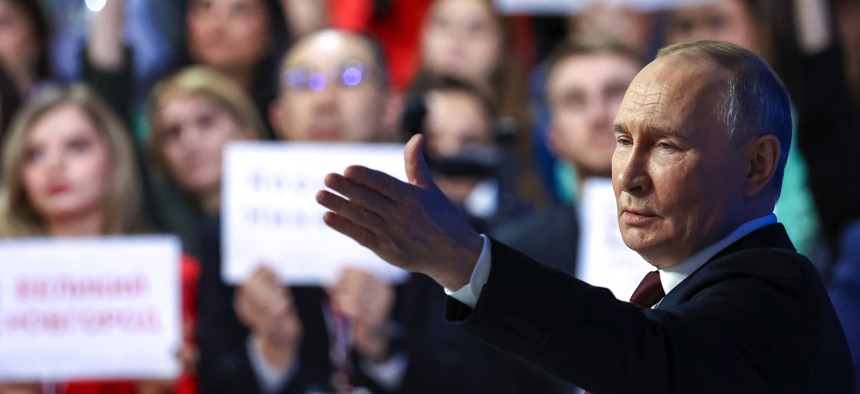
In this pool photograph distributed by the Russian state agency Sputnik, Russia's President Vladimir Putin holds his annual end-of-year press conference in Moscow on December 19, 2025. Alexander KAZAKOV / POOL / AFP via Getty Images

Russian hybrid warfare has become indistinguishable from politics
The war of realities in 2026 will determine the reality of war in 2027.
“The new [U.S.] National Security Strategy does not list Russia as an enemy or a target. Nevertheless, the NATO Secretary General is preparing for war with us. How does that make sense?” Russian President Vladimir Putin said, two hours into his Dec. 19 press conference at the Kremlin.
Your answer to that question depends on which of two parallel realities you inhabit: one where Russia is a potential strategic partner of the United States, or one where it is a threat. The contest between those realities will play out on social media, in policy, and possibly through conflict.
The U.S. National Security Strategy, released in December, reads like a founding document of the first reality. It describes Russia as a potential business partner of the United States, no real threat to NATO, and barely a threat to Ukraine. It dismisses, even while acknowledging as a notion held by “many Europeans,” that Russia represents an “existential threat.”
“The truth is that ‘US intelligence’ assesses that Russia does not even have the capability to conquer and occupy Ukraine, what to speak of ‘invading and occupying’ Europe,” the Director of National Intelligence posted on Dec. 20.
The actual threat, the strategy avers, is “activities of the European Union and other transnational bodies that undermine political liberty…creating strife, censorship of free speech.” This view was elucidated earlier by President Trump and Vice President JD Vance. In his February 2025 speech to the Munich Security Conference, Vance shocked the world by criticizing Romania’s decision to a presidential election based on intelligence reports confirming Russian interference. But the U.S. vice president downplayed the evidence as "the flimsy suspicions of an intelligence agency and enormous pressure from its continental neighbors.”
Other activities that undermine political liberty,” according to the strategy, include EU efforts to investigate and regulate U.S. social-media companies. On Dec. 5, the EU levied a $140 million fine on X, owned by Trump supporter Elon Musk, for practices that it said "deceive users,” such as selling verification to users that the site isn’t actually verifying.
“The EU should be supporting free speech not attacking American companies over garbage,” Vance tweeted.
What’s needed, the strategy says, is a policy of “cultivating resistance to Europe’s current trajectory within European nations.”
The White House has already taken concrete steps to punish Europeans it sees as contributing to EU “censorship,” as though to prove the strategy’s rhetoric is more than just political theatre. Just before Christmas, the State Department took aim at what State Marco Rubio described as “organized efforts to coerce American platforms to censor, demonetize, and suppress American viewpoints they oppose.” The State Department issued visa bans against former European Commissioner Thierry Breton and four other people who work for European think tanks that study disinformation on social media.
“When you find yourself repeating Vladimir Putin talking points, it's time for a time-out to look in the mirror. And is it time for some… candid self-assessment,” Brad Bowman, a senior director at the Foundation for Defense of Democracies, told Defense One in December.
To inhabit this reality also requires ignoring, as the new U.S. strategy does, or downplaying—as Vance did in Munich—Russia’s well-documented campaign to loosen European cohesion by backing loudly nationalist, right-wing parties.
For example, Russia has links to Germany’s AfD, which espouses Kremlin-friendly positions and—some German politicians say—uses its roles in the German parliament to gather intelligence for Russian military efforts against Ukraine and the EU.
“One cannot help but get the impression that the AfD is working through a list of tasks assigned to it by the Kremlin with its inquiries” into drone defenses and critical infrastructure, Georg Maier, the interior minister of the German state of Thuringia, told the Handelsblatt newspaper.
AfD officials have denied the claim.
Russia has used X to boost other pro-Russian politicians across Europe, efforts that Elon Musk has helped by making it harder to track Russian disinformation efforts on the platform, often using the same “censorship” rhetoric while ignoring the fact that X is banned in Russia.
EU parliamentarian Alexandra Geese, in a fiery speech Dec. 18, accused Musk, Trump, and Putin of waging “war” on the European Union. The Russian-backed Voice of Europe media network, which includes a website and radio programing, was also able to amplify its reach and achieve a look of legitimacy via the X platform. In this way, Voice of Europe content was the bullet, but X was the delivery mechanism, the gun. Theoretically, that same principle should work for all media outlets, and the most factual and relevant ones would rise to the top. But that’s not what happened.
“Musk systematically downranks—that means censors—speech of pro-European political parties, violating our freedom of expression,” Geese said.“In turn, he boosts pro-Putin parties that want to destroy the European Union, and the evidence from Germany, Poland, and UK, is overwhelming.”
Grand bargains and spheres of influence
The White House strategy signals a hope that Russia, and, by extension, Putin-favored anti-EU parties, can play a role in a future “strategic stability” arrangement wherein Russia, China, and the United States quietly agree to contain themselves within geographically defined hemispheres. What does that look like? On paper, this would look like a map with circles drawn around Europe, Asia, and the Western Hemisphere, the latter of which would be labeled “U.S.”
The strategy also includes an only slightly less literal blueprint for a more “stable” new world order. It describes this as the “Trump Corollary” to the 1832 Monroe Doctrine, effectively a blueprint for exactly such a carve up.
Russian President Vladimir Putin is a fan of the idea that only a few countries possess true “sovereignty,” as he put it in 2017. The other, non-sovereign nations (Ukraine especially) belong within the sphere of influence of another nation, such as Russia. His kinetic war against Ukraine aims to reduce that country to a Russian oblast; the hybrid war he is waging across Europe aims to break the EU into more controllable bits—as former Trump national-security expert Fiona Hill testified in 2019.
Trump’s push to illegally annex Greenland less Russia or China do it first plays to the same Monroe-doctrine thinking. But the Jan. 3 abduction of Venezuelan dictator Nicolas Maduro provides a vivid example of a new doctrine in action.
While the Caracas raid stunned the world, Hill predicted it—or at least foreshadowed the very limited degree to which Putin would intervene in the event of a U.S. attack on the Venezuelan government, despite decades of investment and allyship with the Maduro regime.
“The Russians at this particular juncture [March and April of 2019] were signaling very strongly that they wanted to somehow make some very strange swap arrangement between Venezuela and Ukraine … They were basically signaling: You know, you have your Monroe Doctrine. You want us out of your backyard. Well, you know, we have our own version of this. You're in our backyard in Ukraine.”
Trump’s claim that the U.S. must control Greenland (an autonomous territory under Denmark) for the sake of its “security,” despite a long-term agreement between Denmark and the U.S. that allows the U.S. to position forces ther,e only makes sense in a context in which NATO cannot live up to its Article 5 commitment. Similarly, Trump’s Jan. 17 threat of punative tarrifs against NATO allies for re-inforcing Greenland’s security is logical only in a world where NATO is a destabilizing force, not a vital alliance to defend Europe from Russian aggression.
A Dec. 30 New York Times article lays out in detail how the “stability” view came to dominate White House policy toward Russia during Trump’s second term, beginning with Trump asking Steve Witkoff to establish a back channel—“a business guy to a business guy”—with Russian government officials during the transition period between the Nov. 2024 election and Trump’s 2025 inauguration. The article describes “a phalanx of Ukraine skeptics led by the vice president, JD Vance, and like-minded officials he seeded at the Pentagon and elsewhere in the administration,” such as defense policy undersecretary Elbridge Colby. Colby and other officials were “eager to start withholding munitions” and refused to provide evidence of Ukrainian military gains on the battlefield.
After the U.S. strategy’s release, the Russian government’s chief spokesman described the strategy as “consistent with our vision.”
Except, of course, it isn’t.
The second reality
If the first reality is one where the world is “stable” because China, Russia, and the United States have agreed to partition it geographically, the second reality is one where Putin continues to regard the U.S. as an eternal threat—or the “stronger” of the two, in the words of one former senior White House official. In other words, an adversary Russia can bargain with, so long as such bargains serve the larger goal of fracturing and weakening the other party.
Russia’s own 2023 "Foreign Policy Concept” document repeats this view, listing as a goal to “eliminate the vestiges of domination by the US and other unfriendly states in global affairs.”
The inhabitants of this second reality see Russia as a growing threat even though European militaries are stronger on paper than Moscow's, with bigger budgets, newer tanks, ships, soldiers, etc. A journal article by Russian Adm. Igor Kostyukov acknowledges the same.
In this reality, Putin has turned to cyber attacks, open election interference, sabotage, arson, assassination attempts, and other “hybrid war” tactics because a conventional war would be futile. Russia’s goal here is to sap resources and create an environment of instability.
Polish Chief of the General Staff, Gen. Wiesław Kukuła, said Russia’s Nov. 17 sabotage attack against Polish rail, on top of months of drone incursions over NATO territories, shows “the adversary has begun preparing for war. They are building a certain environment here that is intended to undermine public trust in the government.”
Russia’s increasing drone incursions are perhaps the best example of this. They seek to normalize the presence of Russian drones over European skies, George Barros, the Geospatial Intelligence Team Lead at the Institute for the Study of War, told Defense One. Once adversary drones become a regular feature of life in Europe, it becomes much easier to use them in a conflict. Russia’s attacks on infrastructure serve a similar purpose, making democratically elected leaders look helpless as air or rail traffic grinds to a halt and no one is certain why.
NATO’s Supreme Allied Commander lives in this second reality. “Hybrid threats are a real issue, and I do think that we can anticipate more of that happening," Gen. Alexus Grynkewich, told reporters at the alliance’s military headquarters outside the Belgian city of Mons on Dec 4.
In this reality, the EU is not a threat to Europe, but a crucial partner. And that partnership is visible in joint projects and activities. Both the United States and the European Union are supporting Ukraine financially and militarily, and working together on the challenge of stopping Russian drone incursions elsewhere. In a September press conference Grynkewich described the EU’s drone wall initiative as “very aligned with some of our thoughts of fortifying our eastern flank from a land and air domain perspective.”
Drone incursions and infrastructure attacks aren't the only way the Kremlin seeks to undermine public confidence. “Russia pursues a systematic strategy of undermining elections and influencing public opinion in the West,” the Carnegie Endowment wrote last February. “EU and NATO countries must recognize that Moscow often acts through agents within their own borders, and build resilience to such interference.”
ISW’s Barros concurred. “The Russians are trying to drive wedges and break unity. It manifests differently in different EU countries…Russia crafts bespoke narratives to target specific countries and target demographics within those countries. It's very savvy, sophisticated, and there's rarely a single unified universal message.”
The second reality—but not the new NSS—also acknowledges the growing coordination between Russia, China, Iran, North Korea. Russia and China have been open about their goal of reducing the size and influence of the United States.
“Russia has strengthened its relationships with the CCP, North Korea, and Iran,” Gen. Dan Caine, the Chairman of the Joint Chiefs told lawmakers in June.
Lawmakers are listening, even if they are not in total agreement. The recently passed National Defense Authorization Act, among its various provisions such as continued support for Ukraine and European Command’s force posture in Europe, also includes the DISRUPT Act, which requires multiple federal agencies to establish task forces and prepare strategies for countering Russian, Chinese, North Korean, and Iranian cooperation.
In other words, Congress realizes that Dictators United is a threat and they’ve acted on that realization by ordering U.S. agencies to do something. But many in Congress still support Russia’s anti-E.U. activities in Europe because many of them still share Russia’s goal of a weaker E.U., one less capable of penalizing U.S. companies. The result is contradictory and self-defeating policy, a mess.
These areas of contention illustrate the contest between realities. In one reality, Putin is a rational actor who poses no real threat to Europe and can be satiated with stolen land and sanctions relief.
In the other reality, an agreement where Russia keeps stolen land and escapes sanctions is a victory for Putin and a loss for the United States. In the 2025 book “If Russia Wins,” Carlo Masala, a former deputy director of research at the NATO Defence College in Rome, suggests that such a victory would enable Putin to re-arm, stage limited incursions in Estonia and elsewhere, and complete his efforts to fracture Europe.
“Russia's goal, as it has repeatedly stated, goes beyond Ukraine. It wants to roll back the European security architecture to its 1997 state,” Masala told Defense One over email. “At the same time, this war is also an important part of the struggle for a new world order. A Russian victory in Ukraine could further encourage China to pursue its hegemonic ambitions in Asia, and especially towards Taiwan, more decisively than before.”
Ultimately, he said, China and Russia might succeed in replacing the United States and allied democracies in global influence.
That such an outcome would be disastrous for the United States is obvious to those who dwell in the second reality. But the Trump administration, and at least some of its supporters, live in the first reality. And it’s not clear how to convey the danger to the second group in a social media environment that is more and more vulnerable to wide-scale distortion, manipulation, and suppression of reality.
Blaise Metreweli, the new head of Britain's foreign intelligence agency, remarked in a Dec. 15 speech: “Falsehood spreads faster than fact, dividing communities and distorting reality….We are now operating in a space between peace and war.”
Former Russian foreign and prime minister Yevgeny Primakov, a key influencer of Putin, might agree.
Primakov served as prime minister only briefly, between 1998 and 1999, but is largely credited with turning the country away from the West after the fall of the Soviet Union. He is also a sort of conceptual grandfather to the idea of modern hybrid warfare, or, perhaps, simply the guy who returned Soviet active measures to the Russian playbook. Deception and corruption can interchange with military force to achieve objectives.
For Primakov, the world between peace and war, where institutions were menacing or incompetent, and where citizens and leaders lived in realities of alternative facts, was a comfortable space to exist. It looked like the Russia he knew.