

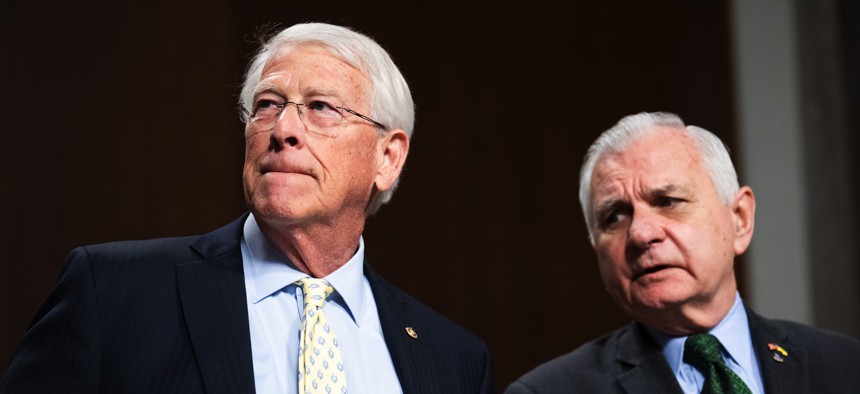
Chairman Roger Wicker, R-Miss., left, and ranking member Sen. Jack Reed, D-R.I., arrive for the Senate Armed Services Committee hearing on "Low-Cost Munitions," in Dirksen building on Tuesday, March 24, 2026. Tom Williams/CQ-Roll Call, Inc via Getty Images
National Defense Strategy ‘falls short’ on nuclear, space threat: SASC chair
Russian space weapon is ‘very significant,’ head of U.S. Strategic Command says.

Count the chairman of the Senate Armed Services Committee among the defense-policy experts who say the National Defense Strategy is inadequate in key ways.
At a Thursday hearing, Sen. Roger Wicker, R-Miss., said the defense policy’s tepid treatment of satellites and nuclear weapons might encourage Chinese and Russian ambitions.
“It’s no secret that I believe this NDS falls short in several areas,” Wicker told U.S. Strategic and Space Command leaders gathered to testify. “I am particularly concerned that the current strategy does not address space and nuclear threats with anywhere near the urgency they deserve.”
The NDS makes only passing mention of Russia's efforts “to modernize and diversify” its nuclear arsenal. It mentions space as one of several areas where “direct military threats to the American Homeland have also grown in recent years.”
Wicker raised concerns about Russia’s reported development of a space-based nuclear anti-satellite weapon, saying it would be a “major game changer.”
Lawmakers first began warning about such a device in early 2024. A few months later, Biden officials said a suspected Russian testbed satellite had been in orbit for two years, but that the weapon was not operational—a claim Moscow denied. (Find a description of Russian and Chinese concepts of operations here.)
The Trump administration’s NDS does not mention the weapon, which Adm. Richard Correll, the head of U.S. Strategic Command, said is “very significant” and something the U.S. military must prepare for.
“Russia has indicated, and has been publicly acknowledged, that they're working on a nuclear capability that could be placed in space,” Correll told lawmakers. “We have to account for it in terms of the architecture that we have and what we can do about it. The department's very focused on that. We do have some options.”
Gen. Stephen Whiting, head of U.S. Space Command, said that a nuclear anti-satellite weapon would be devastating not only to the U.S., but any country that operates in outer space.
“That would be an indiscriminate weapon that, if detonated on orbit, would immediately place at risk every country's space capabilities in low Earth orbit—the United States, China, Russia, Japan, Europe, you name it,” Whiting said. “That would violate the Outer Space Treaty and would not be a development, obviously, that we can tolerate.”
When asked how soon Russia could field such a nuclear space weapon, neither Correll or Whiting provided a public answer to lawmakers.
Some senators expressed concern that the Trump administration has so weakened trust in the American “nuclear umbrella” that European leaders are considering launching the kind of atomic-weapons programs they long ago forswore.
Sen. Jeanne Shaheen, D-N.H., asked Correll whether he was concerned by that development. The Navy admiral responded that he detected “no change” in attitudes from allies.
“At every opportunity in mil-to-mil engagements, I reinforce our extended deterrence commitment on the part of the United States,” Correll said.
The National Defense Strategy called for supporting U.S. interests in the Western Hemisphere and said the government would “increase burden-sharing with allies and partners around the world.”
Similarly, Sen. Elizabeth Warren, D-Mass., told Correll that NATO allies’ refusal to heed President Trump’s requests for help with his war on Iran have made the U.S. government's international relationships look weak to Russia and China.
Correll told Warren he disagreed with her assessment and said the military relationship with allies remains strong and that China and Russia believe that to be the case, too.
Warren told the Navy admiral that his answer lacked “any credibility.”
“Russia and China watch us insult our allies, then beg for their help, and then our allies don't give that help, and you think Russia and China think ‘there is an alliance that's working just great?,’” Warren said. “It is not only an embarrassment when the President begs and our allies say no, it is a national-security threat, because our enemies take note of that.”