

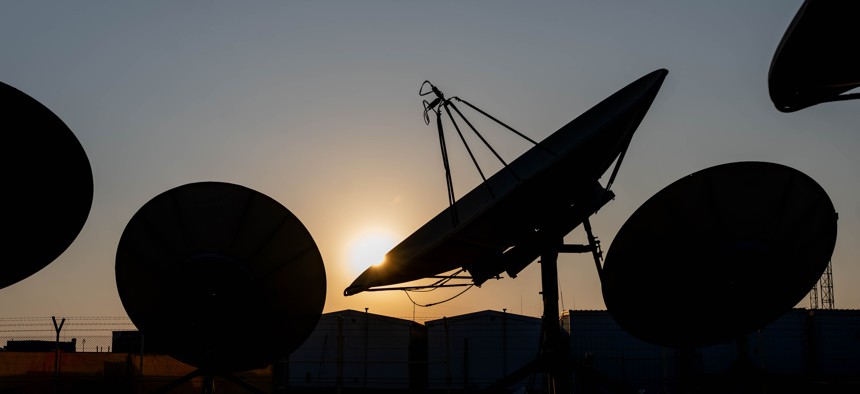
A 2024 photo shows U.S. Space Force antennas in the U.S. Central Command area of responsibility. Senior Airman Violette Hosack / U.S. Air Forces Central

US must adjust to Iran’s use of commercial satellite photos, Space Command says
CENTCOM’s declaration of “space superiority” hasn’t prevented Tehran from putting space to use.

COLORADO SPRINGS, Colorado—Iran’s use of commercial space imagery to strike U.S. and allied targets will force the Pentagon to adjust, the head of U.S. Space Command said.
“We have to recognize that the rest of the world can now see the entire planet transparently and almost 24/7 and so we have to be able to operate in that environment successfully,” Gen. Stephen Whiting, the head of U.S. Space Command told reporters Tuesday during the Space Symposium conference here.
U.S. Central Command, which leveled Iran’s nascent space command in the opening days of the war, more recently announced that the U.S. military had achieved “space superiority” over its enemy. Despite those quick victories, Whiting acknowledged that the conflict has still taught him that even less-equipped adversaries can still inflict damage using commercial satellite imagery and that the U.S. military’s space assets remain key targets during major operations.
“Every country, just about today, can somehow access space imagery, which then gives them an insight on what's going on in the battlefield,” Whiting said. “I think we need to be cognizant of that.”
A day before Whiting spoke, the chairman of the House Select Committee on China wrote to the Pentagon, asking how Iran came by the imagery it used to attack U.S. troops. In the letter, which was obtained by Defense One, Rep. John Moolenaar, R-Michigan, alleged there was a “high likelihood" that satellite photos taken by Airbus were provided to China's MizarVision ahead of Iran’s March 27 attack on Prince Sultan Air Base in Saudi Arabia.
The Europe-based company says it’s not true.
"Airbus denies these allegations, and this letter contains many inaccuracies regarding our operations and commercial relationships,” an Airbus spokesperson told Defense One. “We strictly comply with all applicable sanctions, export controls and international regulatory frameworks."
Moolenaar wrote that Airbus should “follow suit” with other commercial satellite imagery companies that have stopped releasing photos of the region. Planet Labs and Vantor, two of the U.S.’s leading satellite image providers, have limited customers’ access
“This decision reflects our responsibility to ensure that our services do not inadvertently increase risks to civilians or to U.S., allied, or partner forces given the highly dynamic and rapidly evolving conditions in the region,” Vantor said in an emailed statement to Defense One.
In harm’s way
Space Force guardians, as well as other troops supporting SPACECOM and CENTCOM, are working within reach of Iran’s missiles and drones.
During the press conference, Whiting took a moment to remember Army Staff Sgt. Benjamin Pennington. The soldier was assigned to Fort Carson’s 1st Space Battalion, 1st Space Brigade, and was killed in the March 1 attack on Prince Sultan Air Base.
Gen. Chase Saltzman, the Space Force’s top uniformed officer, has previously said guardians deployed for Operation Epic Fury had continued to launch space effects “despite being under attack from an adversary.”
Whiting said the U.S. military’s space capabilities will remain key targets for enemies who will seek to “balance their inferiority in conventional arms” in future conflicts. That includes Iran.
“Even a medium power like Iran will seek to target our space capabilities,” Whiting said. “We do not live in an era of sanctuary anymore, and so our systems need to be resilient to those kinds of attacks, be able to operate through those attacks.”