

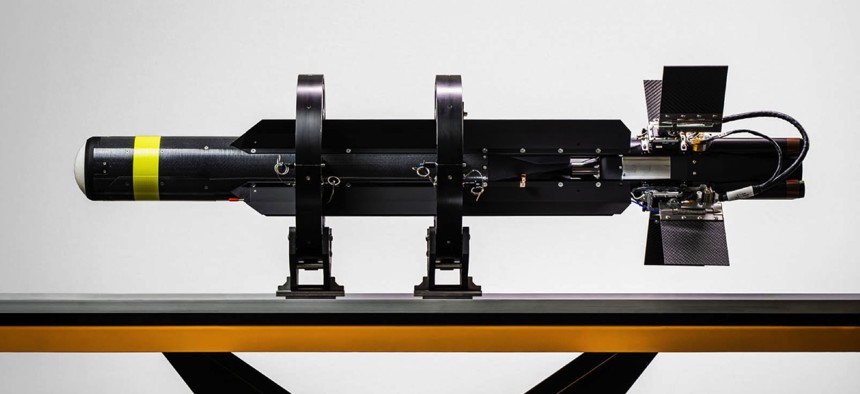
Coyote counter-drone missile Raytheon


War boosts counter-drone sales, joint ventures
Recent weeks have seen a flurry of partnerships by defense-tech companies and orders from nations under fire.
Mideast governments have long invested in air defenses—notably, U.S.-made THAAD and Patriot interceptors—and counter-drone defenses, particularly since the 2019 drone attack on Saudi oil infrastructure at Abqaiq. But recent weeks and months have seen a flurry of activity—in ventures by defense-tech companies and orders from nations under fire.
Last June, SRC announced it would deliver Raytheon Coyote interceptors as part of a $1 billion FMS deal with Qatar. The rail-launched missile has a boost rocket motor and a turbine engine to take down small and large drones and swarms.
In November, MBDA made its first sale of its Sky Warden system to a Middle Eastern country—likely Oman or another of the region’s heavy counter-drone investors. Sky Warden’s weapons include omni- and unidirectional jammers, a CILAS HELMA-P laser, and MBDA’s own Hit-to-Kill and MISTRAL 3 missiles.
On Feb. 28, just before the U.S. and Israel launched their joint attack on Iran, the State Department approved an FMS order to Jordan of Ku-Band Multi-Function Radio Frequency System radars, command and control system; generators; GPS receivers, and related equipment for an estimated $280 million.
On March 19, State approved the sale to the UAE of 10 Fixed Site-Low, Slow, Small Unmanned Aircraft Integrated Defeat Systems for an estimated $2.1 billion. The sale was reported to include 240 Coyote Block 2 All-Up-Rounds, 4-pack Coyote launchers,KuMRFS radars; EO/IR cameras; PYQ-10 Simple Key Loaders; Forward Area Air Defense Command and Control systems; support and test equipment; and other supporting elements.
Joint ventures
Some C-UAS programs can require the integration of more than a handful of elements—radar, electro-optical systems, communications, electronic warfare, command and control, AI, soft-kill jammers, hard-kill missiles, and more. This is leading to more teaming ventures and strategic partnerships—often, companies with niche expertise joining to offer fuller-service C-UAS systems.
On Jan. 7, U.K.-based Babcock International and Estonia’s missile-making Frankenburg Technologies announced an effort to develop an affordable, containerized maritime air defense system against single and massed drones.
Five days later, Axon Vision, a provider of AI-powered solutions for defense applications, said it had received an order from Leonardo DRS for its new AI-based system that detects, classifies, tracks, and intercepts C-UAS. The systems are to participate in operational evaluations and live exercises on manned and unmanned ground platforms.
In late March, Epirus, General Dynamics Land Systems and Kodiak AI joined to introduce the Leonidas Autonomous Ground Vehicle, a commercial truck equipped with Kodiak Driver, an AI-powered autonomous driving system, and armed with Epirus’ Leonidas C-UAS high-power microwave weapon.
More sales
On Jan. 20, Fortem Technologies announced the first deliveries of its DroneHunter 5.0 autonomous interceptor, just weeks after Pentagon’s C-UAS task force cleared the web-equipped quadcopter for sale under the Replicator-2 initiative. Each DroneHunter has two cameras and enough computing power to autonomously engage multiple targets. In February, the company announced another sale: a multimillion-dollar order for DroneHunters to protect U.S. venues at the 11-city, 2026 FIFA World Cup.
On Jan. 26, the Ukraine Navy gave Sierra Nevada Corp. a one-year, $14.9 million cost-plus-fixed-fee contract for C-UAS program field services, maintenance and sustainment. This contract also covers reach-back support for various systems deployed in Eastern Europe under NATO.
Four days later, Norway’s Kongsberg Defence & Aerospace and Polska Grupa Zbrojeniowa received a contract valued around NOK 16 billion from the Polish Armaments Agency for 18 C-UAS batteries.
In February, Lockheed Martin delivered to the U.S. Army the first Sentinel A4 radar system for integration and testing. Sentinel A4 is designed to detect and track small drones, low-flying cruise missiles, and other aerial threats in complex urban environments.
On Feb. 11, Raytheon demoed its microwave-equipped Coyote for the U.S. Army.
The next day, BAE Systems secured a cost-plus-fixed-fee indefinite-delivery/indefinite-quantity contract with a ceiling of $145 million to develop, build, and deliver C-UAS systems. BAE Systems has been marketing its BAE Systems Anti-Threat System, a command-and-control system to spot, classify, and defeat drones.
And the race to develop more drone-killing weapons goes on. On Feb. 19, The U.S. Army Contracting Command issued a request for information to identify new technologies for the Red Sands Hard Kill Challenge in Saudi Arabia, which aims to advance development of “hard kill” weapons to defeat small (Group 1-3) drones in complex and contested environments.