

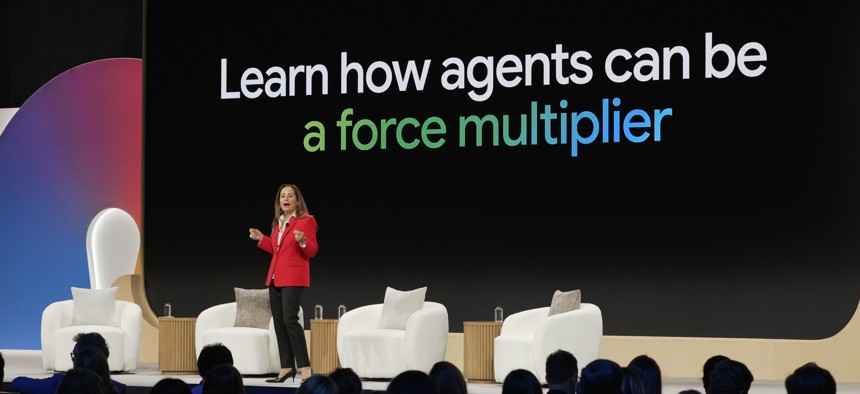
Karen Dahut, CEO of Google Public Sector, speaks at the 2026 Google Cloud Next event in Las Vegas. Govexec / Adam Czarnecki



Pentagon adds Google’s latest model to GenAI.mil as usage soars
Users have built more than 100,000 AI agents using the generative-AI platform, officials said.

LAS VEGAS—Users of the Pentagon’s enterprise-wide generative-AI platform now have access to Google Cloud’s latest and most advanced commercial AI model, Gemini 3.1 Pro, after several weeks of using the software in preview mode.
The software is available to defense users through the GenAI.mil platform and will also be available for all Gemini for Government users across the federal government.
“Gemini 3.1 Pro is Google’s most sophisticated model yet, and it really represents the frontier of American AI,” Pentagon Chief Data Officer Gavin Kliger said in an interview Thursday. “And so the department is working with our engineering team together to make sure we can have this capability available across the department.”
It’s the latest upgrade for the platform, which launched in December with initial plans to integrate Gemini for Government, and later announced plans to incorporate AI models from OpenAI and xAI.
Up to 3 million users have access to GenAI.mil, which is actively being used by more than 1.3 million of them, Kliger said. They are tapping the generative-AI software to automate tasks and workloads, streamline laborious processes, and disseminate and summarize data-heavy documentation in the department’s Impact Level 5 environments, which handle sensitive unclassified data.
Kliger’s team offered several examples of how defense personnel are using generative AI shared by the department. One user at Navy Recruiting Command used Gemini to cut the time to build an automated database to manage personnel and accounts from several years to three months, saving an estimated 10 weeks of labor annually. And a lab director at the Defense Logistics Agency used generative AI to reduce the time to draft statements of work “from weeks to hours,” helping secure $1 million in last-minute funding for a laboratory modernization.
Google Public Sector Chief Executive Officer Karen Dahut said the company’s decision to software-define its commercial cloud and bring it to the government market—as opposed to using physically separate data centers for government users—allows the company to accredit its commercial software faster than competitors. That speed-to-market advantage is most critical in defense missions, she said.
“The key thing is that this [Gemini 3.1 Pro] is our most recent, newest, most capable model, period,” Dahut said on the sidelines of Google Cloud Next in Las Vegas. “So GenAI.mil users are getting it only eight weeks behind all the commercial customers,” who gained access in February.
GenAI.mil, launched on Dec. 9, accumulated 500,000 users within a week and 1 million users within a month “with zero latency issues and zero downtime,” Dahut said.
“No other cloud provider could have launched at that scale,” she said.
Kliger said “one of the cool things about all the growth is that it’s been organic”: the department makes modern AI tools available to its employees but isn’t prescriptive about their use.
Kliger also said increased collaboration with industry is critical in ensuring AI dominance over adversaries including China.“The work we do now is going to set the tone for the next decade, and these are super important technologies for the national defense, our national security,” Kliger said. “China, of course, has a really tight collaboration between the government and its private sector, effectively a controlling relationship. And so making sure we’re engaging with the frontier labs, working together closely like we are with Google, is incredibly important for the nation. Google has been a great partner with the department.”
The Pentagon enters its vibe-coding era
Over the past several weeks, users have tapped another Google Cloud product made available through GenAI.mil, Agent Designer, to vibe-code thousands of agentic AI agents. AI agents are autonomous systems that use large language models such as Gemini to perform tasks without human intervention at each turn.
At the Box Federal Summit Thursday, Jacob Glassman, deputy assistant defense secretary for science and technology foundations in the research and engineering directorate, said users had already built more than 100,000 AI agents on GenAI.mil.
These AI agents have authorizations to operate at IL5, which means they can be used for the department’s most sensitive unclassified data. They also don’t require much coding experience or training to use.
Agent Designer “allows anyone, be they technical or not, to kind of use natural language to describe the system they want to set up,” Kliger said. “One of the big changes we’re seeing is moving from the old concept of the large language models being just a chat interface to being an actual platform where it can run tasks on its own.”