

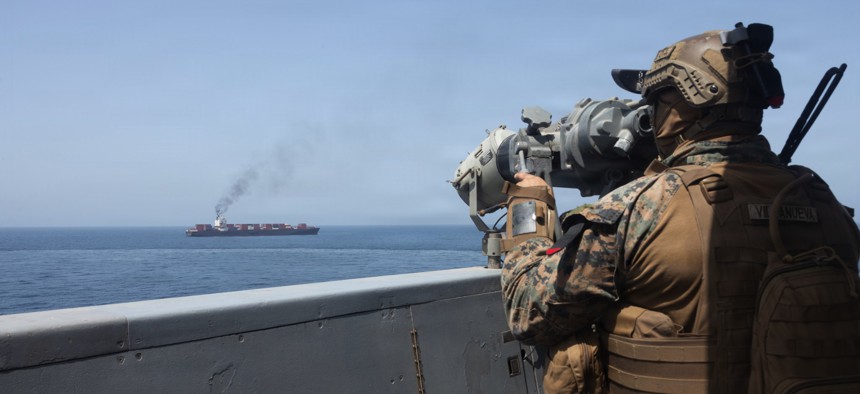
In this handout photo provided by U.S. Central Command, U.S. forces patrol the Arabian Sea near M/V Touska on April 20, 2026. U.S. Navy via Getty Images

Trump’s assumptions are running his Iran policy aground—again
His blunders underscore the importance of a vigorous interagency process.
President Trump’s April 21 decision on to extend his original two-week ceasefire with Iran, less than 12 hours after he expressed reluctance to do precisely that, is giving the U.S. and Iran more time to salvage a diplomatic process defined by misleading statements, rhetorical chest-thumping, and conflicting agendas.
While shooting has stopped for the time being, the standoff over the Strait of Hormuz remains. The good news is that neither the United States’ nor Iran’s best interests are served by a long-term conflict, which suggests both sides are at the very least keen to keep the diplomatic option open in order to determine whether a settlement to the nearly two-month long war is possible. The bad news is that Trump’s poor assumptions about how Iran would react to U.S. pressure tactics have led to poor decisions and a conflict in the Persian Gulf whose outcome remains in doubt. Far from squeezing Iranian leaders into concessions, the U.S. president has repeatedly ceded leverage in negotiation.
Trump is notoriously unpredictable on a lot of subjects, but he’s been quite consistent on Iran throughout his presidency. His objective is clear: to prevent the country from acquiring a nuclear weapon. Presidents George W. Bush, Barack Obama, and Joe Biden all had a similar policy, even if they adopted different strategies for getting there. The difference is Trump’s unwillingness to adapt, his propensity to wield the stick without the carrot, and most of all, his unwarranted confidence in his assumptions.
Trump’s blunders have made the goal harder. The first occurred in 2018, when he withdrew the United States from the 2015 Iran nuclear deal negotiated by the Obama administration. Trump, who said JCPOA offered too much relief from sanctions while imposing too few limits on Tehran’s nuclear activity, launched a “maximum-pressure” strategy on Iran’s leaders that sought to prevent Iranian oil from reaching the global market and to cut off Iranian-linked banks from the international financial system. The hope was that Ali Khamenei, the Iranian supreme leader at the time, would come back to the table on U.S. terms.
This calculation was mistaken. Instead of capitulating, Iran took advantage of the U.S. withdrawal by freeing itself from the deal's nuclear restrictions. More and faster centrifuges were manufactured, installed, and used. Iranian scientists began growing Tehran’s stockpile of enriched uranium. Enrichment, which was capped at 3.67 percent under the deal, moved closer to weapons-grade. And the International Atomic Energy Agency’s access became limited as the Iranians retaliated to U.S. sanctions and IAEA censure.
By November 2023, Iran’s stockpile of enriched uranium was roughly 22 times larger than the deal had allowed. Today, despite last June’s U.S. airstrikes on Iranian nuclear facilities and the thousands since Feb. 28, Iran still has roughly 1,000 pounds of 60-percent enriched uranium—leverage that Tehran wouldn’t have if Trump had chosen to stay in the agreement.
Some would call this ancient history. If so, it’s ancient history that has repeated itself. Trump’s war strategy against Iran leans on the same assumptions and theories at play during his first term: with enough coercion, the Iranian regime will be weakened to the point where the United States can run the table and dictate terms the Iranians will have no choice but to accept. Yet Trump’s war of choice in the Persian Gulf has merely afforded Iran more chips to play with.
Look no further than the Strait of Hormuz. Before the war, the international waterway was open for business. About 120 tankers transited the narrow chokepoint into the Gulf of Oman on a daily basis, servicing approximately one-fifth of the world’s crude oil supply.
The U.S. and Israeli military campaign changed the status quo virtually overnight. Trump, inexplicably, believed Iran would give up before closing the strait. This proved to be a massive error of judgment. Perceiving the war as an existential one, Iran effectively closed the chokepoint, picking and choosing which vessels could enter and interdicting those that tried to bypass its rules.
Traffic through the waterway has since plunged by 95 percent, resulting in price hikes on everything from fuel to fertilizer. Meanwhile, the ongoing U.S. blockade of Iranian ports has merely incentivized Tehran to drag out its own closure. Tehran has since offered to re-open the waterway if Washington ends the war, lifts the blockade and guarantees not to bomb in the future. Once again, the Iranians successfully exploited Trump’s strategy, using it as an excuse to turn the strait into a de facto Iranian lake, which before the war was a non-issue.
Unplugging the strait is now at least as important to the Trump administration as accounting for Iran’s nuclear material, a reality Tehran no doubt understands as it continues deliberating internally about how to manage diplomacy with Washington. Whatever tactics the regime does use, it’s highly unlikely it will agree to Trump’s wishes without a whole host of U.S. concessions in return. Some of those concessions, such as an internationally guaranteed security commitment that the United States will refrain from going to war against Iran in the future, will be difficult for Trump to swallow. Either way, any settlement is bound to be more satisfying to the regime than it needed to be.
There is a fundamental lesson in all of this, one U.S. officials present and future should take heed of: if you’re unwilling to recognize your mistakes out of stubbornness or genuine belief, then they risk exacerbating the very problems you seek to solve. This is why a robust, operational inter-agency process is so important and why Trump himself would do well to expand an inner circle that has thus far been highly restricted. Different departments and agencies will have different opinions on how a particular problem should be managed, what the policy should be and how it should be enacted. Presidents in the past may view these conflicting viewpoints as hindrances to effective decision-making at best and obstructionism at worst. In reality, a full-fledged debate and the existence of a constant feedback loop over what is and isn’t working is precisely how the process should function.
The principals need to speak truth to power. And the president needs to be smart enough to listen.
Daniel R. DePetris is a fellow at Defense Priorities and a syndicated foreign affairs columnist for the Chicago Tribune.
NEXT STORY: How to reopen the Strait of Hormuz