

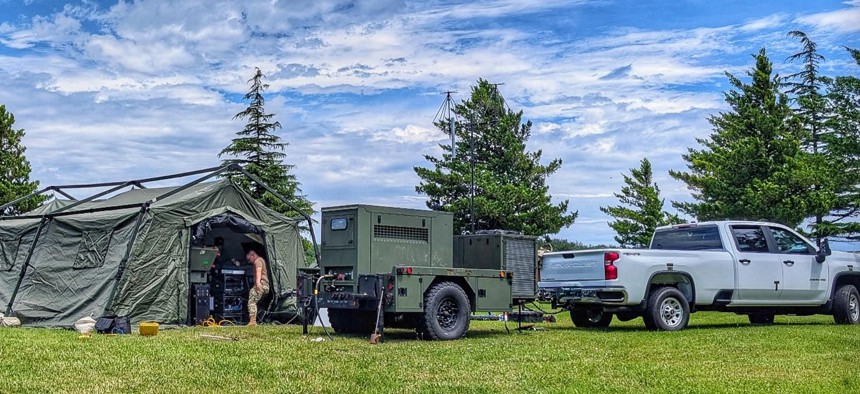
Airmen with the 752nd Operations Support Squadron setup the Tactical Operations Center – Light in Misawa, Japan, during exercise Resolute Force Pacific 2025, July 25, 2025. U.S. Air Force / Morgan Brown

With an eye on China, Air Force hones its hub-and-spoke approach to basing
“The strategic attention is here in this theater,” undersecretary says during a visit to the Indo-Pacific.
JOINT BASE PEARL HARBOR-HICKAM, Hawaii—Today’s Air Force leaders aren’t axing quite all of the previous administration’s efforts to prepare for a possible fight with China. Service leaders are continuing to implement Agile Combat Employment—it's a hub-and-spoke approach to basing, among other things—the service’s undersecretary said last week.
“We cannot just project force and operate out of our main operating bases,” Matthew Lohmeier told a small group of reporters here as he wrapped up a trip around the Pacific.
“There’s an alignment between all of our leaders and making sure we posture ourselves properly to project force here in the region,” he said. “In Washington, D.C., our attention, as far as resourcing goes, is pivoting to this theater, while we attend to all of the other operational efforts that we have around the globe. The strategic attention is here in this theater.”
The why, Lohmeier said, is deterrence.
“We don’t want conflict. We want peace. And there’s no better way to do that than to show that we’re strong as a country, and that we’ve got allies and partners that are increasing their strength as well, and that our relationship is better than it’s ever been before.”
This summer’s Exercise Resolute Pacific was the first time the ACE concept was exercised at scale, Lohmeier said, and the lessons from that are “a constant shaping influence in the future exercises that we plan to execute going forward.”
Lohmeier was confirmed for his position in late July. Air Force Secretary Troy Meink, who had just returned from a trip in the Indo-Pacific encouraged the new undersecretary to follow suit. So in late January and early February, Lohmeier visited U.S. Air Forces Pacific headquarters here, the Maui Space Surveillance Complex in Maui, Osan Air Base in Korea, and Yokota and Kadena air bases in Japan. Along the way, he met with Korean and Japanese military leaders.
In those conversations, Lohmeier said, he talked about “ways in which we can better integrate and use some of their existing capabilities that we don’t have in theater.”
“We know that we don’t always have all of the right answers… and we don’t want our allies to look exactly the same as we do in theater. We want them to also provide asymmetric advantage by bringing to the fight complementary capabilities.”
At the same press conference, Lt. Gen. Laura Lenderman, deputy commander of PACAF, said the command is focused on “setting the theater” with pre-positioned equipment, and ensuring that communication, command and control can be maintained in “a fight that reaches from Alaska to Japan.”
“We know that in a crisis, we won’t necessarily have the time or the capacity…for all of the airlift to flow in time. So having it there, out in the locations, in forward locations—as far forward as it can be—is a priority,” Lenderman said. “And once it gets into theater, moving it around the theater, then becomes a tactical air lift challenge.”
The importance of air mobility was clear in the U.S. strikes on Iran in June, Lohmeier said, and that operation may offer lessons for future missions in the Indo-Pacific.
“One of the parts, critical pieces, of that operation was Air Mobility Command—our ability to refuel. We committed tremendous amount of transport and refueling to ensure a successful operation there,” he said. “It was so utterly impressive what our mobility folks were able to bring to the fight. And now the question is: How do you pivot that into the Pacific, which is a much larger theater, and we’re talking about sustaining conflict?”