

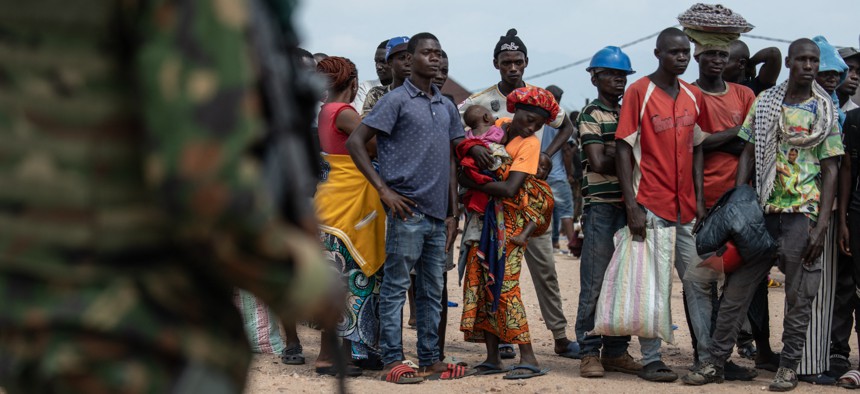
Displaced Burundian nationals line up as they remain stranded on the Congolese side after the closure of the border between the Democratic Republic of Congo and Burundi at the Kavimvira border post on December 14, 2025. Jospin Mwisha / AFP via Getty Images


USAID’s abrupt shutdown increased violence in Africa, study shows
Such shocks motivate armed groups in ways well-planned aid reductions do not.

Last year’s abrupt termination of USAID caused roughly 10-percent increases in conflict events and combat deaths in Africa, according to peer-reviewed research released on Thursday.
The study by European and U.S. researchers examined violence and security in 870 African subnational regions between March 2024 and November 2025. It found that the swift collapse of aid boosted violent upheaval, such as riots, “battles” (sustained armed combat between organized groups), and attacks on governments and civilians.
The researchers say the increase in violence may have less to do with the withdrawal of aid than with the no-notice way the Trump administration shut down the U.S. Agency for International Development in early 2025.
“The sudden, unexpected shock creates that chaos. It shuts down the local economy, it obliterates wages, and it destroys what we call the ‘outside option’,” said Austin Wright, an associate professor at the University of Chicago who co-wrote the study.
Such shocks motivate armed groups in ways well-planned aid reductions do not.
“Abrupt large-scale aid withdrawals that represent an adverse economic shock that reduces the opportunity cost of conflict are likely to lead to more violent events, whereas the reduction of appropriable rents as a consequence of an aid withdrawal might lead to a reduction in violent events,” the authors write.
The authors do not suggest that all USAID disbursals were effective. But Wright said the agency’s disappearance had a huge effect on international humanitarian efforts. Its 2024 budget was $21.7 billion, about 0.3 percent of federal spending.
“In terms of the actual level of our giving, that's an incredible shock to the global system” and cannot easily be replaced by private and largely uncoordinated nongovernmental organizations, Wright said.
The study by Wright and his co-authors joins other analyses that suggest the costs of shutting down USAID surpass the savings.
One paper recently published in the medical journal The Lancet estimates that millions of people may die as a result of USAID cuts by 2030.