

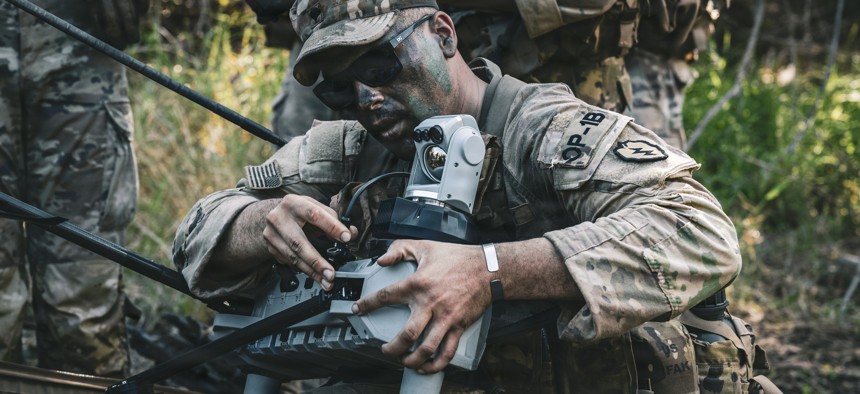
A 25th Infantry Division soldier prepares a U.S. Army C-100 drone for flight during a joint jungle patrol demonstration with the Philippine Army as part of Exercise Balikatan 2026 at Fort Magsaysay, Philippines on April 30, 2026. U.S. Army / Pfc. Peter Bannister


Even as drones usher in an era of ‘cheap kill,’ Army leaders look to what’s next
Uncrewed vehicles were everywhere at LANPAC—even above a general’s head.

WAIKIKI, Hawaii—Drones are everywhere U.S. Army Pacific forces go these days. Last week, the 25th Infantry Division used uncrewed vehicles, vessels, and aircraft to fight a simulated battle on a Philippine beach. This week, two more buzzed about the USARPAC commander’s head as he delivered the keynote speech at AUSA’s Land Forces Pacific symposium.
“For us, innovation is not something we simply talk about, it’s what we put into action every day,” Gen. Ron Clark said.
“This drone, the Kestrel, was produced by our soldiers at The Forge,” he said, indicating a first-person-view quadcopter that can be adapted to drop munitions or for one-way attack. The other was a Skydio X10, which is used for short-range reconnaissance and surveillance.
“In today’s fight, we should never send a soldier when we can send an unmanned system,” Clark said.
Protecting against enemy drones is also a high priority, I Corps commander Lt. Gen. Matthew McFarlane told a small group of reporters here.
“As we’re seeing the absolute proliferation of drones, the importance of passive defense measures can’t be overstated,” McFarlane said.
That includes things like putting command posts underground, or covering them so they are not easily detectable from the air, he said. “We’re very conscious of making sure we’re protecting ourselves from the real air threat that we’re seeing around the world.
Indo-Pacific Command leader Adm. Samuel Paparo highlighted the proliferation of drones in his keynote speech, describing one of three “meta-trends” he believes are reshaping warfare as “the commoditization—and by commoditization, I mean everybody has it—of small, cheap unmanned systems.
“It's expanded access to core capabilities once reserved for great powers,” he said. “Proliferated unmanned systems have made cheap kill, at scale more possible, more probable. Has made a traditional assault—ground assault, air assault, airborne assault, amphibious assault—much more costly than is in our formal doctrine,
In Ukraine, the Russians lose “approximately 100 human beings per square kilometer of ground that they take and that then they subsequently lose,” Paparo said, calling the Ukraine war “a wide laboratory of the commoditization of cheap kill.”
But while the U.S. Army, and the defense industry, have wasted no time applying lessons from Ukraine about unmanned systems, they must not stop there, Gen. Xavier Brunson warned.
“People will tell you that the lesson from the fight in Ukraine is drones, drones, drones, drones. I beg to differ,” said Brunson, the commander of United Nations Command, Combined Forces Command, and United States Forces Korea.
“That's surface, and that's easy. Don't Occam's razor strategic things. Don't just say the simplest solution is going to be the solution. That's not it.”
Brunson urged attendees to think about “the next thing,” which he believes will be commercial space.
“Oftentimes we learn the wrong lessons and we get stuck with them because it’s easy,” he said. “Listen, I am not against…the development of drones. I’m not saying that at all. What I’m saying is we can’t be stuck there. We have to keep going forward. Warfare, if nothing, is about offset, and what I continue to think about when I’m awake at night in the bed is, what is the next offset? Because if we don’t think about that, if we don’t give ourselves to the thought of the next offset, we’ll be doing drones 10 years from now, and thinking that’s still the way.”