

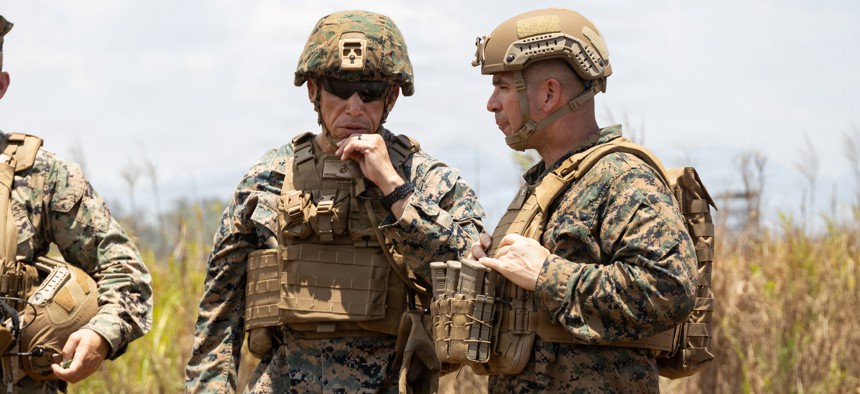
U.S. Marine Corps Brig. Gen. Omar Randall, left, commanding general of the Marine Air-Ground Task Force for Exercise Balikatan 2026 speaks with Col. Gabriel Diana, commanding officer of 3rd Marine Littoral Regiment, 3rd Marine Division, during the integrated air and missile defense event as part of Balikatan 2026 at Naval Station Leovigildo Gantioqu, Philippines, April 28, 2026. Photo by Sgt. Atticus Martinez, Exercise Balikatan



Philippine exercise showcased Marine Littoral Regiment’s growth
3rd MLR basically did exactly what it was designed to do,” Col. Gabe Diana said.

Exercise Balikatan was “a real strategic victory” that showed how far the 3rd Marine Littoral Regiment has come, its commander said.
“There's a lot more growth to happen, there's a lot more work. But this was a pretty good year to kind of showcase something that went from concept to a real capability that certainly the joint force and the combined force is appreciative of,” Col. Gabe Diana told Defense One by phone from the Philippines, where he was preparing for exercise Kamandag.
During Balikatan in May, “3rd MLR basically did exactly what it was designed to do, and that’s serve as a forward distributed stand-in force that’s capable of then integrating joint and combined combat power inside of a strategically significant maritime area here.”
The Hawaii-based 3rd MLR was activated in 2022 as the first unit of its kind. The Corps in 2023 transitioned a unit in Okinawa into the 12th Marine Littoral Regiment and last year scrapped plans for an additional MLR. The units specialize in warfare in the shallow waters near the shore and were designed for operations in the Indo-Pacific.
During Balikatan, the 3rd MLR served as mission commander for the joint task force maritime strike, Diana said, which included U.S. Army, Navy, Air Force, and Marine Corps capabilities as well as troops from the Philippines, Japan, and Canada.
“We were able to synchronize sensors, intelligence, aviation, maneuver formations, long-range precision fires, from across the combined joint force,” he said. “I think for us, I think the key takeaway here is that we were able to operationalize a lot of the stuff that the commandant is talking about with ‘any sensor, any shooter.’”
The regiment also served as mission commander for maritime key terrain security operations in the northern part of the Philippines, and as mission commander for the integrated air missile defense during Balikatan.
Even getting from Hawaii to the Philippines quickly was a learning opportunity, Diana said.
“There were challenges, but it really replicated some of the fog and friction that you would see if you had to close the force in crisis,” he said. “So it was just an excellent rep, to have to close in a very short amount of time, and then integrate into a larger combined joint architecture, and then get right into the fight.”
And while the regiment demonstrated growth, Diana said the exercise was not a “spike the football” moment. Rather, he said, it was a “demonstration of capability… a data point that says, ‘yes, we can do these things,’ and we’ll continue to mature those capabilities.”
“This is a journey, not a destination,” he added.